View:7610Time:2026.07.31
Custom marathon medal ideas are no longer only about choosing a round shape, adding a race logo, and selecting gold, silver, or bronze plating. For modern race organizers, a marathon finisher medal is part of the event identity, the participant experience, and the post-race marketing strategy. A well-designed medal can become a photo-worthy object that runners proudly share on Instagram, Facebook, TikTok, and running communities. In many cases, the medal is the last physical memory a runner takes home from your event, so it should feel meaningful, collectible, and closely connected to your race story.
Today’s runners expect more than a standard award. They are attracted by unique marathon medals with strong visual impact, interactive race medals with moving parts, 3D sculpted details, glow-in-the-dark effects, city landmark themes, and multi-distance series designs. A medal can communicate the spirit of the city, the difficulty of the course, the energy of the community, and the value of completing the race. For race organizers, this means medal design is not a small procurement decision. It is a branding decision.
This guide explores practical and creative marathon finisher medal design ideas for 5K, 10K, half marathon, full marathon, relay, trail running, night races, virtual races, charity runs, and multi-race challenge events. It also explains how to use cultural symbols, premium craftsmanship, color systems, ribbon design, and collectible structures to create medals that runners want to keep, display, and share.
Shenzhen Vistarts Craft Co., Ltd. works with custom medals, badges, keychains, trophies, metal cards, gifts, jewelry, and event commemorative products. With a self-owned factory, more than 50 modern machines, 5 production lines, over 20 designers, and extensive experience in event medal projects, Vistarts helps race organizers transform early design concepts into production-ready medals with stable quality and reliable delivery.
For a marathon organizer, the medal is one of the most visible brand assets of the entire race. It appears in registration promotions, event countdown posts, finisher photos, race recaps, sponsor campaigns, and participant reviews. When runners decide whether to join a race again, they often remember the course, the atmosphere, the organization, and the medal. A medal that feels generic may be quickly forgotten. A medal with a strong story can become a reason to register.
Good custom marathon medal ideas combine three elements: visual attraction, emotional value, and production feasibility. Visual attraction makes the medal stand out online. Emotional value makes runners feel connected to the achievement. Production feasibility ensures the design can be manufactured within budget, quantity, and deadline. The best medals are not always the most expensive. They are the medals where design, material, structure, and race identity work together.
A medal can also influence how sponsors and partners view your race. A high-quality medal helps make the event look professional and well-organized. If sponsor logos, local symbols, or charity messages are integrated tastefully, the medal becomes a long-term exposure tool instead of a one-day giveaway. This is especially valuable for city marathons, tourism races, brand-sponsored running events, and annual race series.
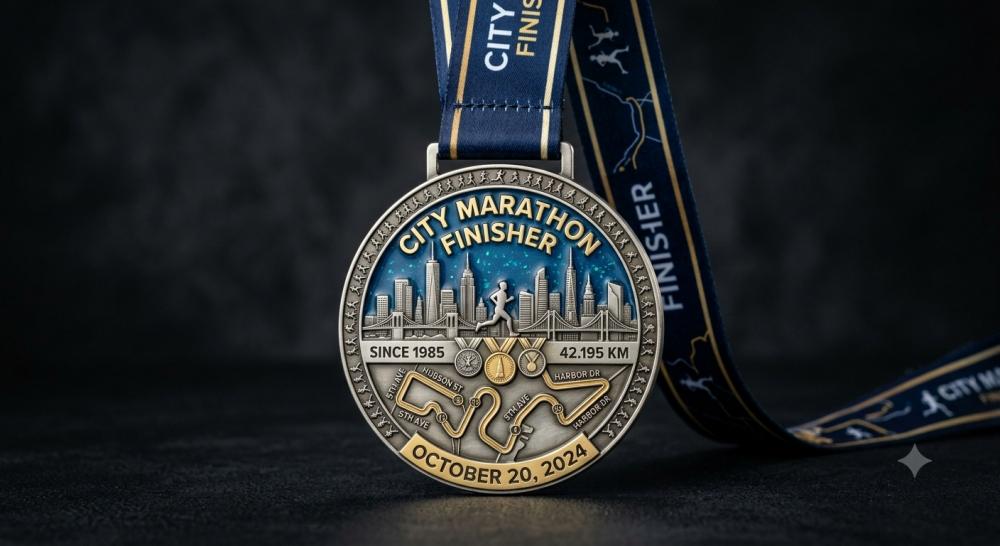
A successful marathon finisher medal design should be easy to recognize, pleasant to photograph, comfortable to wear, and meaningful to the runner. It should include the race name, distance, year, and one or two strong visual elements. Too many small details can make the medal look crowded, while too little detail can make it look cheap. The key is balance.
For example, a city marathon medal may use a skyline silhouette, a bridge cutout, and a color palette inspired by the local flag. A trail race medal may use mountain textures, wood-like enamel, or antique copper plating. A night run medal may use glow-in-the-dark enamel and reflective ribbon printing. Each choice should support the event story.
One of the strongest approaches for unique marathon medals is to connect the medal design with the host location. Runners often travel for races, and many see the medal as proof that they completed a specific challenge in a specific city or region. By incorporating local landmarks and cultural symbols, organizers can turn a medal into a souvenir with a deeper sense of place.
Local elements make the medal more personal. They also help differentiate your event from other races. A flat round medal with only a logo may look similar to many others, but a medal shaped around a bridge, mountain, coastline, temple, stadium, or historic district instantly becomes recognizable. This is especially useful for tourism marathons, destination races, university runs, community events, and city anniversary races.
Architecture and skyline silhouettes are popular because they are easy to understand at first glance. They also work well with metal production processes such as die casting, stamping, 3D relief, cutout designs, and dual-tone plating. A skyline can be placed at the top of the medal, used as a background layer, or cut out to create depth and shadow.
For a city marathon, organizers can highlight landmarks such as towers, bridges, museums, stadiums, city gates, waterfront buildings, or famous streets. For coastal races, waves, lighthouses, beaches, and sunrise shapes can create a strong local feeling. For trail marathons, mountains, forests, rivers, and elevation lines can be used as the main design language.
Skyline designs are also very suitable for collectible race medals. If your event is held every year, each year’s medal can feature a different landmark from the same city. Over time, runners may want to collect the full series. This approach can encourage repeat registration and build stronger event loyalty.
Cultural elements can make a medal feel more emotional and memorable. Instead of only showing a place, the medal can tell a story about the people, traditions, history, and spirit behind the event. This is especially helpful for races connected to festivals, heritage routes, charity causes, regional tourism, or national celebrations.
Possible cultural motifs include traditional patterns, local animals, folk legends, indigenous art styles, historical symbols, ancient maps, classic typography, regional flowers, traditional instruments, or meaningful colors. When used respectfully and accurately, these elements help runners feel that the medal represents something larger than the race itself.
For example, a marathon in a historic town could use an antique brass finish, engraved street map lines, and a raised old-town gate. A cultural festival run could use bright enamel colors, traditional border patterns, and a ribbon inspired by local textiles. A charity race could integrate symbolic elements related to hope, health, community, or remembrance.
Cultural design should be handled carefully. Race organizers should avoid random decorative patterns that have no real connection to the location or audience. A good medal manufacturer and design team can help convert cultural references into production-ready artwork while keeping the design clean, respectful, and suitable for metal craftsmanship.
Interactive race medals have become highly popular because they create surprise and encourage social sharing. Runners enjoy medals that move, spin, open, stack, connect, or serve another function. These designs are especially effective for races that want to create online attention before and after the event.
A medal with moving parts is naturally more interesting in short videos. When runners can rotate the center, slide a small piece, connect multiple medals, or detach a keychain, they are more likely to show the medal online. This gives the race free user-generated content and creates excitement for future participants.
However, interactive designs must be engineered properly. Moving parts require accurate structure, durable connection points, and careful assembly. If the design is too complex, it may increase cost and production time. The goal is not to make the medal complicated, but to make the interaction meaningful and reliable.
Spinner medals use a rotating center or attached component that can move within the medal frame. They are popular for marathon, cycling, triathlon, and challenge races because movement can symbolize speed, endurance, energy, or course progression. A spinning runner icon, compass, wheel, sun, city seal, or race logo can make the medal more dynamic.
Sliding elements are another strong option. A small runner figure can slide across a bridge, a sun can rise behind a skyline, or a distance marker can move along a course map. This type of design adds a playful element and gives runners a reason to interact with the medal after the race.
For production, spinner and sliding medals usually require separate metal parts, small rivets, or controlled assembly points. The design should be tested to ensure the moving part is smooth but not loose. For large marathon orders, sampling is important before mass production.
Functional medal designs give runners a reason to keep using the item after race day. A medal can include a bottle opener, magnet, belt buckle structure, detachable keychain, coaster-style back, or display stand connection. These features are especially suitable for fun runs, beer miles, charity races, festival runs, trail events, and corporate fitness challenges.
A detachable keychain is one of the most practical ideas. The main medal can remain as a display piece, while a smaller logo charm or distance badge becomes a daily-use item. This increases brand exposure because the race identity travels with the participant. For sponsor-driven events, this can create longer-lasting visibility.
Functional features should match the race personality. A bottle opener may work well for a post-race festival but may not be suitable for a serious charity memorial run. A belt buckle may be excellent for western-themed races or trail ultra events. The function should feel natural rather than forced.
Stacking and interlocking medals are ideal for multi-race challenges. For example, runners may complete a 5K, 10K, half marathon, and full marathon across a weekend or race series. Each medal can work independently, but when placed together, they form a larger image, map, logo, animal, shield, or city scene.
This type of collectible race medal design encourages participants to register for more than one event. It also creates a clear visual reward for completing the full challenge. Puzzle-style medals are especially effective for race weekends, virtual challenges, anniversary series, charity fundraising stages, and city tour races.
Interlocking medals require careful planning from the beginning. The edges, thickness, weight balance, plating direction, and ribbon placement should be considered together. If the medals connect physically, the connection points must be strong and smooth. If they only stack visually, the design should still align perfectly when displayed.
Premium craftsmanship can transform a simple medal shape into a high-value collectible object. The finish affects how the medal feels in the hand, how it reflects light, how it appears in photos, and how runners judge the quality of the race. For race organizers looking for custom marathon medal ideas that stand out, plating, enamel, texture, and 3D depth are essential design tools.
The best finish depends on the event style. A modern city marathon may use matte black nickel with bright gold highlights. A heritage race may use antique copper or antique brass. A night run may use glow enamel. A beach marathon may use translucent blue enamel and wave-shaped cutouts. A mountain ultra may use rough 3D rock textures and antique silver plating.
Plating color gives the medal its first impression. Standard shiny gold is classic and works well for winner awards, but finisher medals often benefit from more creative finishes. Rainbow or anodized-style plating creates a colorful reflective surface that changes with light. It is very attractive for social media photos and works well for modern, youth-oriented, or night-themed races.
Antique copper and antique brass finishes create a vintage and premium feeling. They are suitable for heritage runs, trail marathons, historical city races, and endurance events. Antique plating also helps highlight raised and recessed details because darker areas remain in the lower parts of the design.
Matte dual-tone plating is another strong option. A medal can combine matte gold with shiny gold, antique silver with black nickel, or copper with bright enamel. Dual-tone plating helps separate different design layers and gives the medal a more expensive look without necessarily making the design too complex.
Glow-in-the-dark enamel is one of the most eye-catching effects for night runs, Halloween races, neon runs, winter races, and twilight marathons. It creates a surprise after dark and encourages runners to take photos or short videos. Glow effects can be used for stars, moon shapes, route lines, city lights, race logos, or finish-line text.
Translucent enamel allows light to pass through the color layer, creating a glass-like effect. It is ideal for water, sky, gemstones, flames, sunrise, stained-glass themes, and abstract backgrounds. When combined with textured metal underneath, translucent enamel can create depth that standard flat color cannot achieve.
These special effects should be used with intention. Too much glow enamel may reduce the premium appearance in daylight. Too many translucent areas may increase production complexity. A balanced design usually uses special enamel as a highlight rather than covering the entire medal.
Cutouts and 3D sculpted textures are powerful tools for unique marathon medals. Cutouts remove parts of the metal to create open spaces, making the medal feel lighter and more dimensional. They are ideal for bridge shapes, skyline windows, mountain gaps, runner silhouettes, map outlines, and logo frames.
3D sculpted textures add physical depth. Instead of a flat raised logo, the medal can show layered mountains, realistic waves, shoe tread patterns, road textures, brick walls, stadium seating, or a high-relief runner figure. 3D molding makes the medal feel more like a sculpture than a flat souvenir.
High-relief designs are especially useful for premium marathons and anniversary medals. They photograph well because shadows naturally form around raised details. When paired with antique plating, the depth becomes even more visible. This is one reason 3D marathon medals are often perceived as higher value by runners.
Many race events now include multiple distances, such as 5K, 10K, half marathon, full marathon, relay, kids run, and challenge races. A smart medal system helps participants immediately recognize their distance while keeping the entire event collection visually consistent. Instead of designing each medal separately, organizers should build a medal family.
A medal family uses shared design elements such as the same outer shape, same city symbol, same ribbon style, same typography, or same central logo. Then each distance is differentiated through size, plating, enamel color, ribbon color, or icon details. This creates a professional and organized event image.
Color is the easiest way to separate race distances. For example, 5K may use green, 10K may use blue, half marathon may use purple, and full marathon may use red or gold. These colors can appear in the enamel, ribbon, distance number, or background elements.
Ribbon design should not be treated as an afterthought. The ribbon is visible in finisher photos and often covers a large visual area. A high-quality custom ribbon can include the race logo, date, city name, sponsor logo, distance color, and small graphic patterns. When medal and ribbon are designed together, the final product looks much more complete.
Color-coded systems also help volunteers distribute medals quickly and reduce confusion at the finish line. For large events, operational clarity matters. If each distance has a clearly different ribbon and medal color, the award process becomes smoother.
Scaled medal sizes are another effective strategy. A shorter distance can receive a smaller medal, while the full marathon medal is larger and heavier. This creates a natural hierarchy and makes the full marathon reward feel more prestigious.
A common approach is to use approximately 3.0 inches for 5K or 10K, 3.5 inches for a half marathon, and 4.0 inches or larger for a full marathon or challenge medal. Ultra marathons and anniversary races may use even larger medals, depending on budget and shipping considerations.
Size should be balanced with comfort and cost. A very large medal may look impressive, but it also increases material cost, weight, packaging needs, and shipping expense. Race organizers should choose a size that supports the event positioning. A local community run may not need an oversized medal, while a destination marathon or premium challenge event may benefit from a larger collectible piece.
| Race Distance | Suggested Medal Size | Suggested Finish | Ribbon Strategy | Design Notes |
|---|---|---|---|---|
| 5K Fun Run | 2.75-3.0 inches | Bright nickel or colorful enamel | Green or orange ribbon | Simple, energetic, sponsor-friendly design |
| 10K Race | 3.0-3.25 inches | Shiny silver or matte silver | Blue ribbon | Clear distance number and race logo |
| Half Marathon | 3.5 inches | Antique silver or dual-tone plating | Purple ribbon | More detailed landmark or route design |
| Full Marathon | 4.0 inches or above | Gold, antique copper, or premium dual-tone | Red, black, or gold ribbon | Premium 3D relief, cutouts, or special enamel |
| Challenge Medal | 4.0-5.0 inches | Custom premium finish | Special challenge ribbon | Spinner, interlocking, oversized, or multi-layer design |
Different race concepts require different medal solutions. The table below compares common custom marathon medal ideas based on visual impact, production complexity, and ideal application. Race organizers can use it as a starting point when planning their marathon finisher medal design.
| Medal Idea | Best For | Visual Impact | Production Complexity | Social Media Potential |
|---|---|---|---|---|
| City skyline medal | City marathon, tourism race, annual race | High | Medium | High, especially with recognizable landmarks |
| Spinner medal | Premium marathon, anniversary race, challenge event | Very high | Medium to high | Very high due to movement and video appeal |
| Glow-in-the-dark medal | Night run, neon race, Halloween run, twilight marathon | High in dark settings | Medium | Very high for photo and video sharing |
| 3D relief medal | Trail marathon, full marathon, high-end event | Very high | High | High due to premium texture |
| Interlocking medal set | Multi-race weekend, challenge series, virtual challenge | Very high as a complete set | High | Very high because runners want to show the full collection |
| Functional medal | Festival run, beer run, corporate event, fun run | Medium to high | Medium | High if the function is fun and easy to demonstrate |
| Antique cultural medal | Heritage race, historical city run, charity memorial event | High | Medium | Medium to high, depending on storytelling |
Creative ideas are important, but race organizers also need a clear production plan. A medal project usually includes concept discussion, artwork preparation, 3D rendering, quotation, sample approval, mold production, mass production, QC inspection, packaging, and shipping. The more complex the medal, the earlier the planning should start.
If the medal uses a simple flat design with standard plating and enamel, the process may be relatively straightforward. If the medal includes spinner parts, 3D high relief, translucent enamel, glow effects, multiple connected medals, or custom packaging, it requires more time for engineering and sample checking.
To receive an accurate quotation, organizers should prepare the medal size, estimated quantity, race distance categories, design reference, preferred material, plating color, ribbon requirement, packaging method, and delivery location. If the event date is fixed, it is important to mention the final required arrival date, not only the race date.
Clear information helps avoid repeated communication and reduces the risk of misunderstanding. If you already have an AI file, CDR file, PSD file, JPG, PDF, or logo file, it can be used for artwork development. If you only have a basic idea, a professional design team can help create a workable design based on your event story and budget.
| Category | Options | Why It Matters |
|---|---|---|
| Material | Zinc alloy, stainless steel, aluminum alloy, PVC, leather, mixed materials | Controls medal weight, durability, shape complexity, and overall cost |
| Core Process | Die casting, stamping, rotating casting, die cutting, printing, enamel | Determines the structure, surface detail, and production feasibility |
| Surface Finish | Shiny gold, matte gold, silver, bronze, copper, antique finish, rainbow finish | Creates the first visual impression and affects photo performance |
| Coloring | Soft enamel, hard enamel, translucent enamel, glow enamel, UV printing | Adds event color, sponsor identity, and special visual effects |
| Structure | Flat, 2D raised, 3D relief, spinner, sliding part, interlocking set | Defines the medal’s uniqueness and interactive value |
| Ribbon | Printed ribbon, woven ribbon, color-coded ribbon, sponsor ribbon | Improves branding and helps separate race distances |
| Packaging | OPP bag, bubble bag, velvet pouch, paper box, gift box, custom display box | Protects the medal and improves perceived value for premium events |
Vistarts is not only a supplier of metal medals. We are a custom craft manufacturer with experience in business metal cards, gifts, promotional products, jewelry, trophies, badges, keychains, event commemorative products, and marathon medals. This broad manufacturing background gives us strong control over metal processing, surface finishing, printing, engraving, assembly, and packaging.
For race organizers, the key challenge is not only finding creative custom marathon medal ideas. The real challenge is turning those ideas into stable mass production. A design may look excellent on screen, but if it cannot be produced within budget or delivered before race day, it becomes a risk. Vistarts focuses on practical design, controlled production, and deadline management.
Vistarts has a self-owned factory with strong manufacturing capacity. Our production space covers over 10,000 square meters, supported by more than 150 employees, over 50 modern machines, 5 production lines, and over 20 professional engineers. This allows us to handle diverse medal processes, including die casting, stamping, enamel, polishing, plating, laser engraving, printing, assembly, and packaging.
A self-owned factory gives race organizers better communication and better control. When design adjustments are needed, our sales, design, engineering, and production teams can coordinate directly. This reduces the delays that often happen when working through multiple middle layers.
Vistarts has a design team of over 20 professionals. They are not only graphic designers. They understand medal structure, mold limitations, plating effects, enamel areas, production cost, and packaging requirements. This helps customers create designs that are visually attractive and realistic for manufacturing.
For marathon medal projects, our designers can help develop concepts based on city landmarks, local culture, route maps, runner emotions, sponsor branding, and multi-distance systems. We can also provide 3D high-definition rendering to simulate lighting, metal texture, color filling, and depth before production. This helps race organizers make decisions with more confidence.
Vistarts follows ISO9001 quality management and has passed ISO45001 and ISO14001 certifications. Our medal products are CE and RoHS certified. The factory has also passed Disney and Universal Studios audits, reflecting strong standards in production management, compliance, and quality control.
Our dedicated QC team checks raw materials, production processes, plating, colors, assembly, and finished products. We strictly control mass production quality to match the approved sample. For race organizers, this is critical because medal color difference, plating defects, wrong ribbons, or delayed delivery can affect the entire event experience.
Marathon medals are deadline-sensitive products. Unlike ordinary promotional goods, they must arrive before a fixed event date. Vistarts works with more than 10 logistics channels to provide faster, more flexible, and cost-effective shipping options. Our sales team has more than 3 years of medal order follow-up experience and understands how to communicate production progress, packing status, and shipping requirements clearly.
Whether you need medals for a local 5K, a half marathon, a full marathon, a virtual challenge, or a large international event, delivery planning should begin early. A good supplier will not only make the medal but also help manage time risk.
Race organizers can create social-media-friendly medals by focusing on strong visual identity, interactive details, and emotional storytelling. Medals that include city landmarks, 3D relief, spinner parts, glow-in-the-dark enamel, oversized shapes, or interlocking structures are more likely to be photographed and shared. The medal should look good in hand, on the ribbon, and against the race background.
Another important point is to design for the camera. High contrast plating, clean typography, clear distance numbers, and shiny raised details help the medal stand out in photos. A custom ribbon with bold colors also improves finisher photos. If the medal has a moving part, runners are more likely to record a short video, which increases social media reach.
The budget for a high-end 3D marathon medal depends on size, thickness, material, plating, mold complexity, enamel type, moving parts, ribbon, packaging, and order quantity. A larger 3D medal with antique plating, translucent enamel, spinner structure, or custom packaging will cost more than a simple flat medal with standard enamel.
Race organizers should not only compare unit price. They should also consider design support, sample quality, mass production consistency, shipping cost, and delivery reliability. A cheaper medal may become expensive if it arrives late, has plating defects, or does not match the approved sample. For accurate pricing, it is best to provide size, quantity, artwork, process requirements, and deadline to the manufacturer.
Marathon organizers should start the design proofing process as early as possible, especially for premium or interactive race medals. For standard medals, early planning still helps ensure enough time for artwork, quotation, sample confirmation, production, packing, and shipping. For spinner medals, interlocking medal sets, glow effects, 3D relief designs, or custom packaging, additional time should be allowed for engineering and sample adjustment.
A practical approach is to begin medal concept planning several months before the race date. The earlier the organizer confirms the design, the easier it is to control cost, avoid rush shipping, and reduce delivery risk. If the event has multiple distances or sponsor approval steps, extra time should be added for internal review.
For a first-time race, the best custom marathon medal ideas are usually clean, meaningful, and production-friendly. A city landmark medal, route-map medal, shield-shaped medal, or simple 3D logo medal can create a strong first impression without becoming too complex. Race organizers can use custom enamel colors and printed ribbons to build brand identity.
If the budget allows, adding one premium feature such as cutouts, antique plating, glow enamel, or a small 3D element can make the medal feel more special. It is better to choose one strong idea and execute it well than to combine too many effects into one crowded design.
Yes. One design concept can be adapted into a full multi-distance medal series. The outer shape, event logo, and main landmark can stay consistent, while the distance number, enamel color, ribbon color, plating, or size changes for each race category. This approach creates a professional event identity and makes the full set more collectible.
For example, 5K can use a smaller medal with bright color, 10K can use a slightly larger silver design, half marathon can use antique silver with more detail, and full marathon can use a larger gold or dual-tone finish. Challenge medals can be designed to connect with the other medals or stand as a premium centerpiece.
Interactive race medals can be suitable for large marathon orders if the structure is designed correctly and tested before mass production. Spinner parts, sliding elements, detachable charms, and interlocking structures require careful engineering. The manufacturer should confirm the connection method, movement, durability, thickness, and assembly process before bulk production.
For large orders, it is important to approve a sample or detailed production proof first. This helps avoid issues with loose parts, uneven spinning, sharp edges, or inconsistent assembly. Working with an experienced medal factory can reduce these risks.
If you are looking for custom marathon medal ideas that can help your race stand out, Vistarts can support you from concept to final delivery. Whether you need unique marathon medals for a city race, interactive race medals for a challenge event, collectible race medals for a multi-year series, or a premium marathon finisher medal design with 3D relief and special effects, our team can help turn your idea into a production-ready solution.
With a self-owned factory, over 20 designers, 50+ modern machines, 5 production lines, ISO system certification, CE and RoHS certified medals, and experience in large event medal projects, Vistarts is ready to support race organizers, event agencies, sports brands, and marathon committees worldwide. Contact us today to request a custom design proposal, medal quotation, 3D rendering, or full catalog of marathon medal solutions.

58 South Union Road, South Union Community, Shenzhen, Guangdong, China