View:9111Time:2026.08.04
Wholesale custom race medals are one of the most important procurement categories for marathon organizers, half marathon event companies, 10K and 5K race directors, sports marketing agencies, charity race planners, and large-scale competition operators. When an event needs 500, 2,000, 5,000, or even 10,000+ medals, the project is no longer a simple product purchase. It becomes a supply chain decision involving price tiers, mold and setup costs, sample approval, quality control, production scheduling, packaging, freight, customs clearance, and strict delivery deadlines.
Ordering race medals in bulk can significantly reduce the unit price, but high-volume purchasing also increases risk. A small artwork mistake can be repeated across thousands of medals. A plating inconsistency can damage the event’s brand image. A delayed shipment can create a serious race-day problem. A weak ribbon attachment can affect the participant experience. For B2B buyers, the goal is not only to find cheap bulk race medals, but to find a reliable medal supplier for marathons that can deliver stable quality at scale.
Before placing a custom medals bulk order, event organizers should evaluate four core decision areas: pricing structure, quality control, logistics management, and production timeline. These four factors determine whether a large medal order becomes a smooth procurement success or a costly operational failure.
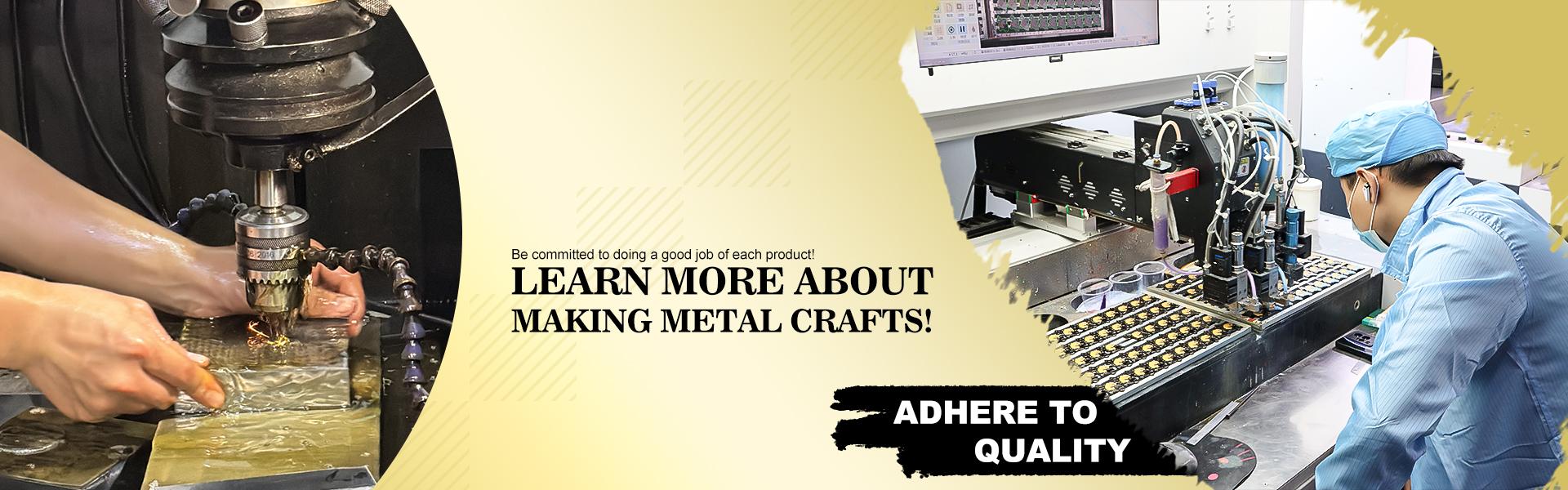
Shenzhen Vistarts Craft Co., Ltd. is a factory specializing in custom medals, badges, keychains, trophies, business metal cards, promotional gifts, jewelry, and event commemorative products. With a self-owned factory of more than 10,000 square meters, over 150 employees, 5 production lines, more than 50 modern machines, over 20 professional designers, ISO9001 quality management certification, CE and RoHS certified medals, and experience serving major international events including the Paris Olympics, Qatar World Cup, and renowned marathon events, Vistarts provides factory direct race medals for organizers who need both competitive pricing and reliable delivery.
Bulk race medal procurement is different from ordering a small batch of souvenir medals. When the quantity reaches 500, 2,000, 5,000, or 10,000+ pieces, every detail becomes more important. The design must be production-ready. The mold must be accurate. The plating must remain consistent. The ribbons must be stitched securely. The packaging must prevent scratches during long-distance shipping. The freight method must match the race date. The supplier must understand that a marathon medal is not just a product, but a deadline-sensitive event asset.
For race organizers, medals are emotional touchpoints. They are received by runners after months of training, travel, registration fees, and personal effort. A medal represents achievement, community, brand value, and race memory. If the medal quality is poor, participants may complain online. If medals arrive late, the event reputation can be seriously affected. That is why choosing the right supplier is essential for any custom medals bulk order.
Wholesale custom race medals should be planned with the same level of seriousness as timing systems, race bibs, finisher shirts, hydration stations, and venue permits. A high-volume medal order requires clear specifications, confirmed artwork, sample approval, QC inspection, logistics planning, and a safety buffer before race day.
A professional factory direct race medals supplier can help organizers avoid unnecessary costs while improving reliability. Instead of simply quoting a price, the supplier should help evaluate medal size, material, thickness, plating, ribbon type, packaging method, mold reuse, shipping options, and customs requirements. This consultative support is especially valuable for event companies managing multiple races across different cities or countries.
Large-volume orders can deliver major cost advantages. The unit price of custom medals usually decreases as quantity increases because fixed costs are spread across more units and production becomes more efficient. For event organizers, this can make bulk ordering a smart strategy, especially for annual races, multi-distance events, race series, corporate sports events, and large charity runs.
However, the lowest unit price should not be the only decision factor. Buyers should calculate total landed cost, including mold fees, sample fees, packaging, freight, customs duties, import taxes, delivery destination, and possible warehousing. A professional purchasing decision looks beyond the product price and evaluates the full cost of receiving finished medals on time and in good condition.
Bulk pricing is one of the main reasons organizers choose wholesale custom race medals. A 500-piece order may already qualify for better pricing than a small promotional batch, but the cost reduction becomes more noticeable at 2,000 pieces and even stronger at 10,000+ pieces. This is because labor setup, machine adjustment, artwork preparation, mold creation, plating setup, and production scheduling become more efficient when the factory runs a larger batch.
For example, producing 500 medals may require almost the same initial design and setup work as producing 2,000 medals. The mold must still be made. The artwork must still be confirmed. The plating process must still be arranged. The ribbon must still be printed. When these fixed tasks are spread across more units, the cost per medal decreases.
At 10,000+ pieces, the factory can plan production more efficiently across equipment, labor, polishing, plating, enamel filling, ribbon assembly, QC inspection, and packaging. The supplier may also negotiate better material use and shipping arrangements. This makes high-volume orders especially attractive for large marathons, national race series, university sports events, charity campaigns, and corporate wellness programs.
Buyers should request clear quantity-based quotations instead of a single price. A useful quote may show pricing for 500, 1,000, 2,000, 5,000, and 10,000 pieces. This helps organizers decide whether ordering extra stock is financially reasonable. Sometimes increasing the quantity slightly can reduce the unit cost enough to justify the additional medals, especially if last-minute registrations are expected.
Mold and setup fees are common in custom medal production. A new medal design may require a mold, die, or production setup depending on the material and process. For small orders, these fees can represent a significant portion of the total cost. For bulk race medals, however, tooling fees become much less important because they are spread across a larger number of pieces.
For example, if a mold fee is divided across 200 medals, the added cost per medal may be noticeable. If the same mold fee is divided across 5,000 or 10,000 medals, the cost per unit becomes very small. This is one of the strongest financial advantages of a custom medals bulk order.
Mold reuse can create even greater savings for annual events. If the race medal design uses the same basic shape, border, logo, or core structure each year, the original mold may be stored and reused. The event can update the year, ribbon, enamel color, or printed insert while keeping the core tooling. This strategy is useful for marathon series, charity runs, school races, club races, and branded endurance events.
Vistarts offers more than 1,000 custom medal design options, including spinning medals, 3D medals, round medals, square medals, custom-shaped medals, glow-in-the-dark medals, and other structures. Our design team understands both craft techniques and process costs, helping organizers create production-ready medal designs that control tooling expenses while still delivering a strong visual result.
Race medals are often heavy, especially when they are made from zinc alloy or iron. For large-volume orders, shipping method has a major impact on total cost. Air freight is faster but more expensive for heavy shipments. Sea freight is slower but usually more cost-efficient for high-volume medal orders. The right choice depends on event deadline, quantity, weight, destination, and budget.
For urgent orders, air freight may be necessary. It is suitable when the race date is close, the quantity is moderate, or the medals must arrive quickly. However, for 5,000 or 10,000+ medals, air freight can become expensive. Organizers should avoid relying on air freight unless the budget allows it or the timeline requires it.
Sea freight is often better for heavy bulk shipments because the cost per kilogram is usually lower. The trade-off is time. Sea freight requires earlier planning, including production completion, export preparation, sailing schedule, customs clearance, inland delivery, and local distribution. For large marathon medal orders, sea freight can provide meaningful savings if the project is started early.
Vistarts partners with more than 10 logistics channels to offer faster, more versatile, and cost-effective shipping options. Depending on the destination and deadline, we can help buyers compare air freight, sea freight, express delivery, and DDP solutions.
| Order Quantity | Typical Buyer Type | Cost Advantage | Key Purchasing Focus | Recommended Strategy |
|---|---|---|---|---|
| 500 pcs | Local race, small charity run, club event | Entry-level bulk pricing | Affordable design and simple production | Use standard shape and limited colors |
| 1,000-2,000 pcs | Community 5K, 10K, school event, regional race | Better unit price and setup efficiency | Artwork consistency and ribbon quality | Approve physical sample before mass production |
| 3,000-5,000 pcs | Half marathon, large charity race, race series | Strong unit cost reduction | Production scheduling and QC checks | Plan freight early and request staged QC updates |
| 10,000+ pcs | Major marathon, national event, corporate campaign | Maximum economy of scale | Supply chain management, customs, delivery margin | Use sea freight when timeline allows and add buffer stock |
Quality control is one of the most important concerns for B2B buyers ordering wholesale custom race medals. In a small order, a few defects may be manageable. In a bulk race medal order, even a small defect rate can create hundreds of problematic units. For marathon organizers, poor QC can lead to participant complaints, sponsor dissatisfaction, and last-minute replacement costs.
A reliable medal supplier for marathons should use a full-chain QC process covering raw materials, mold accuracy, casting or stamping quality, polishing, plating, enamel filling, printing, ribbon attachment, packaging, and final inspection. Vistarts has a dedicated QC team of over 10 personnel and strictly controls mass production quality to match confirmed samples. If bulk quality deviates from the approved sample, our commitment includes a full refund guarantee according to the agreed quality terms.
A physical sample is essential before mass production. Digital artwork and 3D renderings are useful, but they cannot fully show the actual weight, plating reflection, enamel texture, ribbon feel, thickness, or color appearance under real light. A pre-production sample allows the buyer to check whether the medal meets expectations before thousands of pieces are produced.
During sample review, organizers should check the medal size, thickness, weight, logo accuracy, text spelling, year, distance, sponsor logos, plating tone, enamel colors, edge finish, ribbon width, ribbon printing, and attachment method. Any correction should be made before mass casting or stamping begins.
For large events, sample approval should be documented clearly. The approved sample becomes the production standard for mass goods. If multiple stakeholders are involved, such as sponsors, race directors, charity boards, and marketing agencies, all approvals should be completed before production starts. This prevents later disputes and avoids costly rework.
Vistarts provides 3D high-definition dynamic rendering design to simulate real lighting, metal refraction, and detailed texture. This helps reduce decision-making pressure before sampling. However, for bulk orders, physical sample approval remains a critical step for risk control.
Color consistency is especially important for large medal orders. Race brands, sponsors, charities, universities, and corporate events often have specific brand colors. If enamel colors vary across batches, the medals may look inconsistent and unprofessional. The Pantone color system helps reduce this risk by providing a standardized reference.
Before production, buyers should provide Pantone color codes for enamel areas, printed ribbons, sponsor logos, and any printed medal details. The supplier should match these colors as closely as possible based on material, plating, printing method, and enamel characteristics. It is important to understand that colors can appear slightly different on metal, fabric, acrylic, wood, and digital screens.
For bulk race medals, color approval should be included in the sample process. Organizers should review the physical sample under normal lighting and compare it with brand guidelines. If the color is too dark, too light, or inconsistent with the event identity, adjustments should be made before mass production.
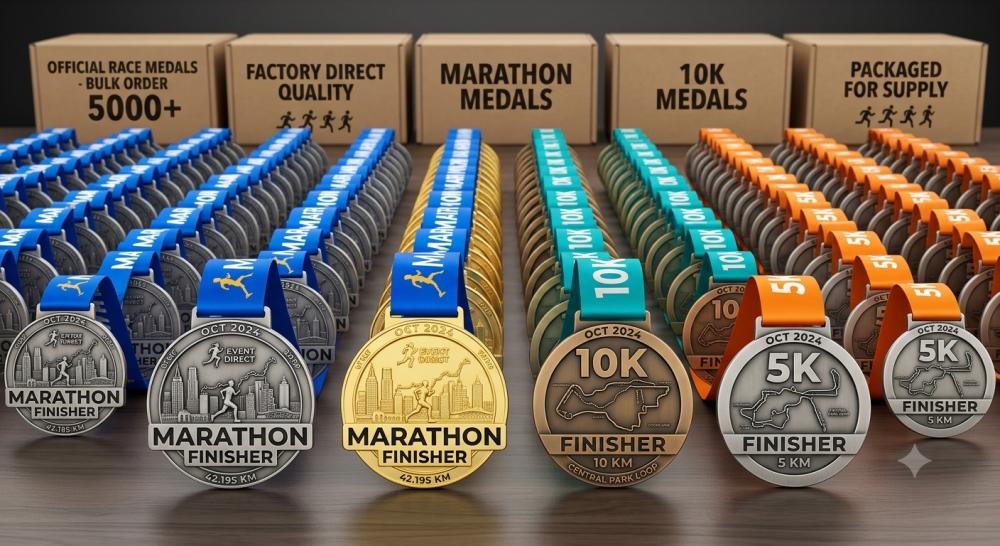
Consistent color matching is also important for race distance categories. For example, a marathon may use gold, a half marathon may use silver, a 10K may use blue, and a 5K may use green. If colors are not controlled, participants may receive medals that do not match the event’s visual system.
Plating quality affects the first impression of a medal. In bulk production, all medals should have consistent shine, tone, and surface finish. Common plating options include shiny gold, shiny silver, antique brass, antique silver, antique copper, black nickel, matte finishes, and dual-plating effects. Whatever finish is chosen, it must remain stable across the entire order.
Plating issues can include uneven color, dark spots, scratches, dull surfaces, oxidation, or inconsistent antique effects. A strong QC process should identify these issues before packaging. For high-volume marathon medals, random inspection should be combined with process checks at different production stages.
Ribbon attachment is another critical detail. A medal may look excellent, but if the ribbon ring, loop, clasp, or stitching is weak, the product can fail during race-day distribution. Ribbon stitching should be strong and consistent. The ribbon should be attached securely and should not easily detach from the medal. For heavy medals, the attachment structure must be strong enough to support the weight.
Vistarts uses modern machinery, experienced production teams, and full-chain QC to help ensure uniform weight, shine, ribbon attachment, and finished appearance. Our production capabilities support multiple processes while maintaining quality consistency for large medal orders.
| QC Item | What to Check | Why It Matters | Recommended Timing |
|---|---|---|---|
| Physical sample | Size, weight, shape, logo, color, plating, ribbon | Confirms the standard before mass production | Before production approval |
| Artwork accuracy | Spelling, date, race distance, sponsor logos | Prevents repeated mistakes across thousands of units | Before mold and sample creation |
| Pantone color matching | Enamel color, ribbon print, brand colors | Maintains event and sponsor brand consistency | During sample approval and production |
| Plating consistency | Shine, tone, antique effect, surface defects | Affects premium appearance and participant satisfaction | After plating and before assembly |
| Ribbon strength | Stitching, loop, clasp, attachment ring | Prevents medals from falling during use | During assembly and final inspection |
| Packaging protection | Individual bags, separation, carton strength | Prevents scratches and transit damage | Before shipment |
Delivery timeline is one of the most important risks in bulk medal procurement. Race day cannot be postponed because medals are delayed. Organizers must ensure that production, inspection, shipping, customs clearance, and final delivery are all scheduled with enough time. Large orders require more coordination than small orders, especially when multiple cartons, pallets, or freight methods are involved.
The best logistics plan starts before production begins. Buyers should confirm the delivery address, required arrival date, freight method, customs responsibility, tax responsibility, packaging method, and contact person for receiving goods. If medals will be distributed to multiple event locations, split shipment planning should be discussed early.
A 200-piece medal order may be completed relatively quickly because the production volume is small. A 10,000-piece order requires different scheduling. The factory must allocate machinery, workers, plating capacity, enamel filling time, ribbon printing, assembly labor, QC inspection, packaging space, and logistics preparation. Each stage must be planned to avoid bottlenecks.
High-volume orders may also require batch production. For example, medals may be cast or stamped in batches, polished in batches, plated in batches, filled with enamel in batches, assembled with ribbons in batches, and inspected in batches. If any stage is delayed, the entire delivery schedule may be affected.
Organizers should communicate the final event date clearly and ask the supplier for a realistic production schedule. The schedule should include artwork confirmation, sample production, sample shipping if needed, approval time, mass production, QC inspection, packaging, freight pickup, customs clearance, and final delivery.
Vistarts is equipped with 5 production lines and more than 50 modern machines and equipment, which helps us handle diverse crafting requirements and support timely delivery for bulk race medals. Our experienced sales team follows up medal orders carefully to ensure accurate understanding of client requirements and efficient communication.
International medal orders may involve customs duties, import taxes, HS Codes, shipping documents, customs brokers, and destination-country regulations. For B2B buyers, these details can affect both cost and delivery time. If customs clearance is not prepared correctly, a shipment may be delayed at the port or border.
HS Codes are used to classify products for customs purposes. Race medals may fall under categories related to metal articles, awards, promotional items, or similar classifications depending on the material and destination rules. Buyers should confirm with their supplier, freight forwarder, or customs broker to estimate duties and taxes.
DDP, or Delivered Duty Paid, can be helpful for buyers who want a simpler purchasing process. Under a DDP arrangement, the supplier or logistics provider handles duties, taxes, customs clearance, and delivery to the buyer’s address according to the agreed terms. This can reduce administrative burden for event organizers, especially those without import experience.
However, buyers should compare DDP with other freight options. Sometimes DDP offers convenience and predictable landed cost. In other cases, experienced importers may prefer FOB, CIF, EXW, or other shipping terms depending on their internal logistics resources. The best option depends on budget, timeline, destination, and the buyer’s customs experience.
A 2-week safety margin is highly recommended for large medal orders. This means medals should arrive at least two weeks before race day, not one day before. The buffer helps protect the event from production delays, shipping disruptions, customs inspection, weather-related freight delays, address issues, carton damage, or local delivery problems.
The safety margin also gives the event team time to count medals, inspect cartons, organize medals by distance, prepare volunteer distribution stations, attach any additional labels, and handle sponsor or VIP medal sets. If the event includes marathon, half marathon, 10K, 5K, kids’ race, and volunteer medals, sorting can take longer than expected.
For international orders, a 2-week buffer is not excessive. It is a practical risk-control measure. For 10,000+ medals shipped by sea freight, an even longer buffer may be wise. Organizers should work backward from race day and create a timeline that includes every approval and logistics step.
| Time Before Race Day | Action | Purpose |
|---|---|---|
| 12-16 weeks | Confirm supplier, medal concept, budget, quantity, and freight plan | Allows enough time for bulk production and economical shipping |
| 10-12 weeks | Finalize artwork, Pantone colors, ribbon design, packaging, and quotation | Prevents delays before sampling |
| 8-10 weeks | Approve physical sample and production standard | Reduces risk before mass production |
| 5-8 weeks | Mass production, plating, enamel, ribbon assembly, QC inspection | Ensures adequate time for large-volume manufacturing |
| 3-5 weeks | Packaging, freight pickup, export process, customs preparation | Moves goods into the logistics stage |
| 2 weeks minimum | Medals arrive at organizer warehouse or event location | Provides safety margin before race day |
Inventory planning is an important part of bulk medal ordering. Race registration numbers can change quickly, especially in the final weeks before an event. Some runners register late, sponsors request extra sets, volunteers need recognition medals, VIP guests may be added, and replacement medals may be needed for lost or damaged items. Without buffer stock, organizers risk running out of medals on race day.
At the same time, ordering too many extra medals can waste budget and storage space. A smart buffer strategy helps organizers balance cost and risk. The right buffer depends on event size, registration trends, medal personalization, race distance categories, and whether leftover medals can be used later.
A common strategy is to order 5%-10% extra medals beyond confirmed registration numbers. This overflow rule helps cover late registrations, replacement needs, sponsor requests, volunteer awards, media kits, and unexpected participant count changes. For example, if a race expects 2,000 participants, ordering 100-200 extra medals may provide a reasonable safety margin.
The exact buffer should be based on registration behavior. If your event historically receives many last-minute registrations, a 10% buffer may be safer. If registration closes early and numbers are stable, 5% may be enough. For large marathons with multiple distances, buffer stock should be calculated separately by distance because a 5K finisher medal cannot always replace a marathon finisher medal.
Organizers should also consider replacement needs. A small number of medals may be damaged during local handling, lost during setup, or needed for sponsor displays. Having extra stock prevents awkward situations at the finish line. It is better to have a controlled surplus than to disappoint finishers who expect a medal.
Annual events can save time and money by planning reorder strategies in advance. If the event uses a consistent medal shape or main structure, the original mold can often be stored for future production. This reduces tooling cost and shortens preparation time for next year’s race.
A good annual medal strategy balances consistency and freshness. The organizer may keep the same medal outline and event logo while changing the year, ribbon color, plating finish, enamel accent, or distance text. This creates a collectible series while controlling production costs.
For race series, mold reuse can be even more valuable. A city running series may use one medal structure for several events and differentiate them with color, ribbon, center design, or printed elements. This helps build brand recognition and improves purchasing efficiency across multiple orders.
Buyers should ask the supplier how molds are stored, how long they can be kept, and what details can be updated without creating a completely new mold. Clear mold management helps annual events reduce lead time and avoid unnecessary setup fees.
| Event Size | Suggested Buffer | Example Quantity | Reason |
|---|---|---|---|
| 500 participants | 5%-10% | 25-50 extra medals | Covers late entries, replacements, and sponsor requests |
| 2,000 participants | 5%-10% | 100-200 extra medals | Protects finish-line distribution and volunteer needs |
| 5,000 participants | 5%-8% | 250-400 extra medals | Balances large-scale cost with operational safety |
| 10,000+ participants | 3%-7% by distance | 300-700+ extra medals | Should be calculated based on registration data and race categories |
The following planning table summarizes the major decisions B2B buyers should make before placing a large race medal order. It can be used by marathon organizers, procurement teams, sports agencies, schools, charity event committees, and corporate wellness planners.
| Planning Area | Key Question | Recommended Action | Risk If Ignored |
|---|---|---|---|
| Quantity | How many medals are needed per distance? | Use registration forecast plus 5%-10% buffer | Running out of medals on race day |
| Price tiers | How does unit price change at 500, 2,000, 5,000, and 10,000+ pcs? | Request tiered quotation | Missing better bulk pricing opportunities |
| Mold fee | Can the mold be reused next year? | Design a reusable core structure | Paying new tooling fees every year |
| Sample | Has a physical sample been approved? | Approve sample before mass production | Large-scale production mistakes |
| Color | Are Pantone colors confirmed? | Provide Pantone codes and review physical sample | Brand color inconsistency |
| QC | How will the factory inspect mass production? | Confirm QC checkpoints and final inspection | Defective medals reaching participants |
| Logistics | Air freight, sea freight, express, or DDP? | Choose based on weight, deadline, and budget | Unexpected freight cost or delivery delay |
| Timeline | Will medals arrive at least 2 weeks before race day? | Build a safety margin into the schedule | Race-day medal shortage or panic handling |
Large custom medal orders can fail for predictable reasons. The most common problems include unclear artwork, unrealistic deadlines, missing sample approval, weak communication, poor packaging, insufficient buffer stock, inaccurate shipping estimates, and lack of QC standards. Event organizers can reduce these risks by following a structured procurement process.
Artwork mistakes are expensive in bulk production. Before mold creation, confirm spelling, race name, year, distance, sponsor logos, charity names, city names, and official marks. For international events, check whether accented letters, special characters, and translations are correct. A single typo can be repeated across thousands of medals.
Some buyers skip sampling to save time, but this increases risk. A sample allows the organizer to confirm weight, size, plating, colors, ribbon, and overall appearance. For wholesale custom race medals, sample approval is one of the best ways to prevent large-scale problems.
Specifications should include medal size, thickness, material, plating, enamel colors, Pantone codes, ribbon width, ribbon length, ribbon printing, attachment type, packaging method, quantity by distance, delivery address, and deadline. Written specifications reduce misunderstanding and help both buyer and supplier stay aligned.
Heavy medals can scratch each other during transit if packaging is not handled correctly. Individual poly bags, soft separation, protective layers, strong cartons, and proper weight limits per carton can reduce damage. For premium medals, custom boxes or foam protection may be used, but they increase cost and volume. The packaging method should match the medal value and shipping route.
Not every promotional product supplier understands event medal deadlines. A medal supplier for marathons must be able to manage fixed dates, large quantities, consistent quality, ribbon assembly, carton labeling, and logistics coordination. Vistarts has supply chain experience from top-level events such as the Olympic Games and FIFA-related projects, as well as renowned marathon events, giving us practical knowledge of event standards and delivery requirements.
Choosing the right supplier is one of the most important decisions in bulk medal procurement. Vistarts is positioned to support B2B buyers who need factory direct race medals with reliable quality, practical design, cost-effective production, and dependable delivery.
Vistarts operates a self-owned factory with more than 10,000 square meters of plant area, over 150 employees, 5 production lines, and more than 50 modern machines and equipment. This production foundation allows us to handle various medal processes and support large-volume orders with better coordination.
Our team includes over 20 professional engineers and more than 20 designers with hands-on production expertise. This means we do not only design attractive medals; we design medals that can be produced efficiently. We understand how structure, material, plating, enamel, ribbon, and packaging affect cost and delivery.
Vistarts has passed ISO9001, ISO45001, and ISO14001 certifications. Our medals are CE and RoHS certified. Our factory has passed audits by Disney and Universal Studios. These qualifications support quality management, safety, environmental responsibility, and professional production standards for international buyers.
Our dedicated QC team of over 10 personnel manages quality control from raw materials to final products. We strictly control mass production quality to match confirmed samples. For B2B buyers, this sample-based QC approach is essential because it creates a clear standard for bulk production.
Vistarts offers over 1,000 custom medal designs, including spinning medals, 3D relief running medals, round medals, square medals, custom-shaped medals, glow-in-the-dark medals, and other creative structures. Whether your event needs marathon medals, half marathon medals, 10K medals, 5K medals, charity run medals, school race medals, or tournament awards, we can recommend a cost-effective and production-ready solution.
Vistarts cooperates with more than 10 logistics channels to provide faster, more versatile, and cost-effective shipping options. We can help buyers compare air freight, sea freight, express shipping, and DDP options according to destination, weight, race deadline, and budget.
The typical minimum order quantity for factory-direct pricing depends on the medal material, size, process, and customization requirements. In general, buyers can start discussing bulk race medals at around 500 pieces, while stronger wholesale pricing is usually achieved at larger quantities such as 1,000, 2,000, 5,000, or 10,000+ pieces.
For high-volume race organizers, the best approach is to request a tiered quotation. This allows you to compare different quantity levels and understand how unit price changes as volume increases. If your event has uncertain registration numbers, ordering a slightly larger quantity may be cost-effective when the unit price drops significantly.
Large medal orders are usually packaged with protective methods such as individual poly bags, separated medal layers, bubble protection, inner boxes, strong export cartons, and carton weight control. The exact packaging method depends on the medal finish, value, quantity, and shipping route. Premium medals may require stronger protection, while standard bulk race medals can often use efficient protective bulk packaging.
Packaging is especially important for shiny plating, antique finishes, painted details, and printed surfaces. Without proper separation, medals can rub against each other during transit and create scratches. Vistarts checks packaging protection before shipment to reduce the risk of damage during long-distance transportation.
Yes, a bulk order can usually be split into different ribbon colors for different race distances. For example, a marathon may use a red ribbon, a half marathon may use blue, a 10K may use green, and a 5K may use yellow. This is a common strategy for events with multiple race categories.
Buyers should provide clear quantity breakdowns for each ribbon color, distance, and medal type. If the medal face also changes by distance, the artwork and mold requirements should be confirmed early. If only the ribbon changes, the same medal mold may still be used, which can help reduce tooling cost.
The timeline depends on quantity, complexity, sample approval, production workload, and shipping method. For large orders, organizers should generally start planning 12-16 weeks before race day when possible. This allows time for artwork, sample production, approval, mass production, QC inspection, packaging, shipping, customs clearance, and a 2-week safety buffer.
Orders shipped by air freight may arrive faster but cost more. Orders shipped by sea freight usually require more time but can be more economical for heavy shipments. For 10,000+ medals, early planning is strongly recommended.
Air freight is faster and suitable for urgent or moderate-volume orders, but it can be expensive for heavy medal shipments. Sea freight is usually more cost-efficient for large-volume orders, especially 5,000 or 10,000+ medals, but it requires more lead time. The best choice depends on your event deadline, destination, shipment weight, and budget.
If your event date is fixed and the order timeline is tight, air freight may be necessary. If you start early, sea freight can help reduce total landed cost. Vistarts can help compare freight options and recommend a suitable logistics plan.
Yes, in many cases the same medal mold can be reused for next year’s race if the core medal shape and structure remain the same. Organizers can update the year, ribbon, color, plating, or printed elements while keeping the original mold. This can save tooling costs and reduce preparation time for annual events.
To make mold reuse easier, design the medal with a timeless event logo and a flexible area for yearly updates. Discuss mold storage and reuse options with the supplier before placing the first order.
To receive an accurate quotation, provide the medal quantity, size, thickness, material preference, plating type, enamel colors, artwork, ribbon design, packaging requirements, delivery country, target arrival date, and whether you need air freight, sea freight, express delivery, or DDP service. If you are unsure about specifications, share your budget and event type so the supplier can recommend suitable options.
For multi-distance events, provide a quantity breakdown for marathon, half marathon, 10K, 5K, kids’ race, volunteer medals, sponsor medals, and buffer stock. Clear information helps the supplier quote accurately and avoid later cost changes.
If you are planning a marathon, half marathon, 10K, 5K, charity run, race series, school sports event, or corporate fitness challenge, Vistarts can help you create wholesale custom race medals that combine competitive bulk pricing, stable quality, professional design, and reliable delivery. Our factory direct race medals are designed for organizers who need cost control without sacrificing participant experience.
With a self-owned factory, more than 150 employees, over 50 modern machines, 5 production lines, ISO system certification, CE and RoHS certified medals, Disney and Universal Studios audit experience, more than 20 professional designers, and logistics cooperation across more than 10 channels, Vistarts is ready to support your custom medals bulk order from concept to race-day delivery.
Contact Vistarts today to request a bulk quotation, free design suggestions, a full product catalog, or a factory direct solution for your next race medal project. Your next world-class event deserves medals that arrive on time, match the approved sample, and make every finisher proud.

58 South Union Road, South Union Community, Shenzhen, Guangdong, China