View:78402Time:2026.08.04
If you are organizing a marathon, 5K, triathlon, or any timed race, you have almost certainly asked yourself the question: finisher medals vs placement medals — what is actually the difference, and how many of each do I need to order? At first glance both look like "medals," but they serve two completely different purposes. A finisher medal is designed for inclusivity and celebration — every single runner who crosses the finish line earns one, regardless of speed or ranking. A placement medal (also called an award medal or podium medal) is designed for competition and hierarchy — it recognizes only the top performers in each division. Understanding this distinction is essential not just for event branding, but for accurately budgeting your custom medal order, choosing the right materials, and avoiding costly overproduction or, worse, running out of medals on race day.
In this guide, we break down everything a race director, event planner, or sports marketing team needs to know about the difference between finisher medals and placement medals — including design, sizing, materials, manufacturing techniques, order quantities, and budget allocation strategies.
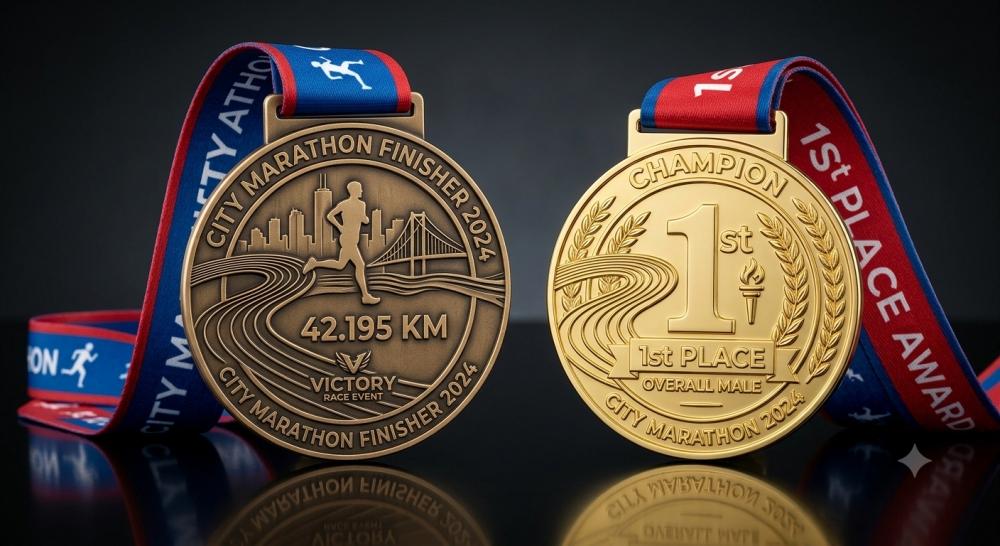
Before diving into the details, here is a quick side-by-side comparison of finisher medals vs placement medals covering definition, purpose, order quantity, size, materials, and typical unit cost.
| Feature | Finisher Medal | Placement / Award Medal |
|---|---|---|
| Definition | A medal given to every participant who completes the race | A medal given only to top-ranked finishers (overall or by category) |
| Purpose | Celebrate participation, effort, and personal achievement | Recognize competitive performance and ranking |
| Recipients | All registered/finishing runners | 1st–3rd place overall, age-group and gender-division winners |
| Order Quantity | High volume — matches or slightly exceeds total registrations | Low volume — precise count based on number of categories |
| Design Focus | Event branding, event date, race theme, uniform design | Hierarchy: gold/silver/bronze finish, rank text, category engraving |
| Size & Weight | Standard size (usually 60–75mm), moderate weight | Often larger and heavier (75–100mm+) for visual prestige |
| Plating | Antique gold/silver/bronze, colorful enamel, or themed finishes | Bright/shiny gold, silver, bronze plating for clear ranking |
| Back Engraving | Usually blank or generic event text | Often custom-engraved (e.g., "Male 30-34 1st Place") |
| Typical Unit Cost* | Lower per-piece cost due to bulk production | Higher per-piece cost due to premium plating and low volume |
*Actual unit pricing depends on size, plating type, mold complexity, and order quantity. Contact your medal manufacturer for a detailed quote.
A custom finisher medal is a commemorative medal awarded to every participant who completes a race, regardless of their finishing time or ranking. It is the medal most runners picture when they think of race day: hanging around their neck at the finish line, celebrating not competition against others, but a personal milestone.
The core function of a finisher medal is emotional and symbolic rather than competitive. It tells every runner — from the elite athlete to the first-time 5K walker — that finishing the race is itself an accomplishment worth recognizing. Because finisher medals are given to the entire field of participants, they also become one of the most powerful marketing and retention tools an event has: runners photograph them, post them on social media, and often keep them displayed at home for years, extending your event's brand visibility long after race day.
Because every finisher receives the same medal, finisher medals typically share one uniform design across the entire batch. Designers focus on elements such as the event logo, event name, race date, host city skyline, mascot, or a theme tied to that year's race (for example, a coastal marathon might feature wave motifs, while a charity run might incorporate the cause's symbol). Popular styles include spinning medals, 3D relief medals, glow-in-the-dark medals, and custom-shaped medals that mirror the event's identity. Because the entire run of medals shares a single mold, this uniformity also helps keep unit costs down.
Finisher medal orders are almost always high-volume — typically matching total race registration numbers, with an additional 3–5% buffer to account for late registrations, damaged pieces, or promotional giveaways. A 10,000-runner marathon, for instance, might order 10,300–10,500 finisher medals. This high-volume nature is precisely why bulk manufacturing pricing and reliable production lead times matter so much when selecting a medal supplier.
A custom award medal — also referred to as a placement medal or podium medal — is reserved for top-performing athletes. Unlike the finisher medal, which celebrates completion, the award medal celebrates competitive achievement and is tied directly to a runner's final ranking.
Award medals exist to formally acknowledge competitive success. This typically includes the overall top three finishers (male and female), as well as winners within specific age-group divisions (e.g., Male 18-24, Female 40-44) and sometimes additional categories such as wheelchair division, team relay, or masters division. Because these medals carry competitive weight, their design must visually communicate rank at a glance.
Award medals are built around a clear visual hierarchy. First place typically receives a bright gold-plated medal, second place a silver finish, and third place a bronze or antique bronze finish. Ribbon colors are often matched to the placement (gold, silver, bronze ribbons) rather than the event-wide ribbon used for finisher medals. Award medals are also frequently produced in a larger diameter or with additional thickness to make them feel more substantial and prestigious when photographed on the podium.
Unlike finisher medals, award medal quantities are calculated with precision rather than bulk estimation. Event organizers typically multiply the number of age-group categories by the number of genders and by the number of ranking positions (usually three). For example, an event with 10 age-group categories across two genders, awarding 1st–3rd in each, would need 60 award medals, plus 6 for the overall male and female top three. Getting this number right matters — under-ordering can mean an embarrassing gap on the podium, while over-ordering wastes budget on premium-finish medals that go unused.
Beyond purpose and quantity, finisher medals and placement medals diverge in several concrete manufacturing details. Understanding these differences helps event organizers communicate clearly with their medal manufacturer and avoid design revisions later in production.
Placement medals almost always use bright, reflective gold/silver/bronze electroplating because the shine reinforces the sense of prestige and competitive rank, and photographs well on a podium. Finisher medals, in contrast, have much more design freedom: antique gold or antique silver finishes are popular for a more vintage, collectible look, while soft or hard enamel fill-in colors let designers match the medal to the event's brand palette, mascot, or route theme.
Many event organizers intentionally scale placement medals up — either in diameter, thickness, or both — compared to the standard finisher medal used for the same event. This size difference reinforces the sense that award medals represent a higher tier of achievement, even when using the same base design elements or mold.
Because placement medals are awarded to a small, known set of winners, manufacturers can economically add custom back engraving — such as the specific age category and placement ("Male 30-34 First Place" or "Overall Female Champion"). This level of individual customization would be cost-prohibitive at the scale of a full finisher medal order, which is another reason the two medal types are typically produced as separate product lines within the same overall order.
Once you understand the practical difference between finisher medals and placement medals, the next step is allocating your medal budget wisely across both categories.
A commonly used budgeting approach among race organizers is a rough 80/20 split: roughly 80% of the total medal budget goes toward finisher medals (because of their high volume, even at a lower unit cost), while the remaining 20% is allocated to a smaller batch of premium-finish placement medals. This ensures every participant receives a quality keepsake while still allowing the top-tier award medals to stand out with heavier plating, larger size, or individualized engraving.
One of the most effective ways to control costs without sacrificing visual distinction is to design finisher medals and placement medals from the same base mold. By keeping the core medal shape and relief design identical, and only varying the plating color (antique vs. bright gold/silver/bronze), ribbon color, or adding back engraving for the award version, event organizers can avoid paying for a second tooling/mold fee entirely. An experienced medal manufacturer with an in-house design and engineering team — rather than a broker who outsources production — can advise on exactly how to structure this shared-mold approach during the design phase, saving both time and money before production begins.
Most 5K races benefit from offering both. Finisher medals reward every participant and strongly encourage repeat registration and social sharing, while placement medals give the race a competitive edge that attracts serious runners and local running clubs. Many smaller 5K events choose to keep the placement medal categories limited (for example, only overall top three, without extensive age-group breakdowns) to control cost while still recognizing top performance.
Calculate this by multiplying your number of age-group categories by the number of gender divisions, then by the number of placement positions you plan to award (commonly three: 1st, 2nd, 3rd). Add a small buffer (5–10%) for ties, category adjustments, or last-minute changes in the results. It is also wise to confirm final category structures with your race management/timing software provider before finalizing your medal order.
Yes — trophies are a valid alternative or supplement to placement medals, and some events use trophies for the overall top three while still using podium medals for age-group winners. The choice often comes down to budget, display/storage needs for winners, and event tradition. Custom trophies typically cost more per unit and take up more space than medals, which is why the majority of race organizers still default to placement medals for age-group awards and reserve trophies (if used at all) for overall category champions.
Choosing between finisher medals vs placement medals is only the first step — the real challenge is getting both produced on time, on budget, and to a consistent quality standard. As a self-owned factory established in 2011 with over 10,000 square meters of production space, 150+ staff, and 5 dedicated production lines, Shenzhen Vistarts Craft Co., Ltd. has manufactured event medals for organizers ranging from local 5K charity runs to internationally recognized events, including experience gained through work connected to the Paris Olympics, Qatar World Cup, and major marathon events worldwide.
Our in-house design team of 20+ professionals understands both the artistic and manufacturing side of medal production, helping you choose the most cost-effective shared-mold strategy for your finisher and placement medal sets. With over 1,000 existing custom medal designs — including spinning, 3D, glow-in-the-dark, and custom-shaped options — plus ISO9001 certification, RoHS/CE-compliant materials, a dedicated 10+ person QC team, and a full refund guarantee if bulk production deviates from your approved sample, Vistarts is built to handle both your high-volume finisher medal run and your precision-engraved placement medal batch under one roof.
Ready to plan your race medals? Contact the Vistarts team today for a free custom quote comparing finisher medal and placement medal options for your next event — visit vistarts.com to get started.

58 South Union Road, South Union Community, Shenzhen, Guangdong, China