View:55466Time:2026.08.20
Ordering custom event medals should be one of the more exciting parts of planning a race — but for first-time organizers especially, it's also one of the easiest places to make a costly, stressful mistake. A small oversight in your medal order — a missed lead time, a spelling error that slipped past approval, a size mismatch, or simply not ordering enough — can spiral into serious pre-race anxiety or, worse, a public-facing PR headache when runners cross the finish line to find there's no medal waiting for them. The good news is that nearly every custom event medal disaster follows one of a handful of predictable patterns, and each one is entirely avoidable with the right planning. Below are the five most common mistakes race organizers make when ordering custom event medals, along with the practical solution for each.
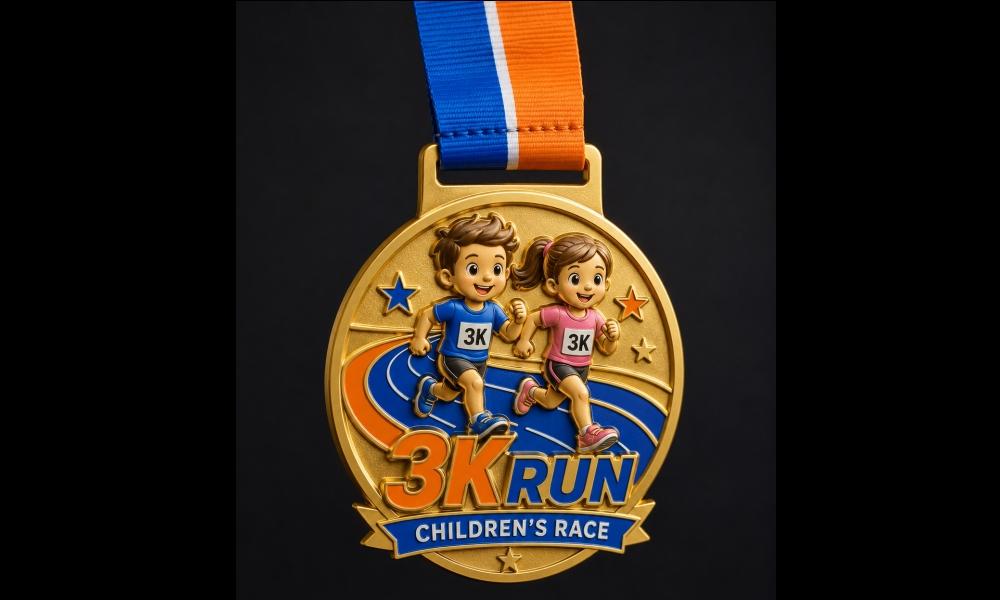
Here's a fast-reference summary of the five most common custom event medals ordering mistakes, what causes them, and the fix — before we break down each one in detail.
| Mistake | Root Cause | Recommended Fix |
|---|---|---|
| Ordering too late | Forgetting shipping/customs time on top of manufacturing time | Build an 8–10 week buffer before race day |
| Text overcrowding | Trying to fit sponsor lists, quotes, and graphics on a small medal face | Follow "less is more" on the front; move details to the back or ribbon |
| Wrong size/thickness | Using one generic size for every distance and age group | Scale size to distance (2.5" for 5K up to 3.5"–4.0" for marathons) |
| Skipping proofs/samples | Approving mass production without confirming color and spelling | Require 2D/3D digital proofs plus a physical pre-production sample |
| Miscalculating quantity | Ordering the exact registration count with no buffer | Add a 5%–10% buffer stock for late sign-ups and damaged pieces |
Of all the mistakes organizers make when ordering custom event medals, timing is by far the most common — and the most expensive to fix once discovered.
Many first-time organizers calculate their medal order timeline based on manufacturing time alone — mold-making, casting, plating, and packing — without accounting for the additional time needed for international freight and customs clearance if sourcing overseas. By the time an order is placed with only a few weeks left before race day, the manufacturing window alone may already be tight, leaving no realistic margin for shipping delays, customs holds, or any production hiccup along the way.
As a general planning rule, organizers should aim to finalize their custom event medals design and place the order at least 8–10 weeks before race day. This buffer typically covers mold-making and sample approval, mass production, quality inspection, and standard sea or ground shipping with reasonable margin for delay. Ordering within this window also avoids being forced into expensive air freight "rush" fees — a common and costly consequence of realizing too late that a standard shipping timeline won't make the deadline.
A visually cluttered medal doesn't just look unpolished in photos — it can also lead to real production problems once the design moves from screen to metal.
It's tempting to try to fulfill every sponsor obligation and creative idea on the medal's front face — sponsor logos, a motivational quote, the event name, the date, a distance marker, and a detailed graphic, all competing for space on a medal that may only be 2.5 inches in diameter. Beyond looking cluttered, very fine text and detail often don't survive the casting process cleanly, resulting in blurred or illegible elements once the medal is actually produced.
Reserve the front of the medal — the "hero side" that gets photographed and remembered — for only your boldest, most essential elements: event name, year, and a primary graphic. Move secondary information like sponsor logos, finisher quotes, and distance details to the back of the medal or onto the printed ribbon, where there's more room to include detail without competing for visual attention. This single discipline solves the majority of overcrowding problems before they ever reach production.
Medal scale communicates achievement level at a glance — and getting it backwards undermines that signal for your runners.
A marathon finisher who trained for months deserves a medal that feels proportionate to the accomplishment — a small, lightweight medal can feel underwhelming next to the achievement it represents. On the flip side, a heavy, oversized medal handed to a young child in a kids' fun run can be genuinely impractical (and occasionally a safety concern for very young participants), in addition to feeling mismatched to the event.
As a general sizing guideline, custom event medals should scale up with distance and competitive weight: roughly 2.5 inches for 5K and similar shorter distances, scaling up to 3.5–4.0 inches (and often greater thickness/weight) for half marathons and full marathons. Kids' fun runs and youth events typically call for a smaller, lighter medal regardless of distance, prioritizing comfort and practicality over visual heft. Working with a manufacturer experienced across multiple event types helps ensure your size and weight choices actually match runner expectations for your specific race category.
Of all five mistakes, this is the one most within an organizer's direct control to prevent — and yet it's one of the most frequently skipped steps under time pressure.
When deadlines feel tight, it's tempting to approve a digital mockup quickly and move straight to mass production. But digital files can hide problems that only become obvious in a physical sample: a Pantone color code that renders differently once cast and plated, a font that doesn't survive the casting process as cleanly as expected, or — most painfully — a spelling error in the event name, sponsor name, or location that slipped through a rushed review. Once thousands of medals are already cast, these errors are extremely expensive and often impossible to fix in time.
Never skip the proofing stage, regardless of how tight the schedule feels. Always request a 2D and, where possible, 3D digital proof before mold-making begins, and for any meaningful order size, request physical pre-production photos or an actual sample piece before authorizing mass production. Build time for this review directly into your 8–10 week planning window rather than treating it as an optional extra step — it is, in practice, the single most effective safeguard against a costly production mistake.
Even a beautifully designed, well-proofed medal creates a problem if there simply aren't enough of them on race day.
Ordering precisely the number of currently registered runners seems logical on paper, but it fails to account for late/day-of registrations, packages lost or damaged in transit, medals damaged during event setup or storage, and staff error at the finish line. Running out of medals — even for a handful of runners — creates an immediate, visible, and often socially amplified negative experience right at the emotional high point of the race.
A simple, widely used safeguard is ordering 5–10% more custom event medals than your current registration count. This buffer comfortably absorbs last-minute sign-ups, in-transit damage, and finish-line handling losses without meaningfully increasing your per-unit cost, since the marginal cost of a small percentage increase on a bulk order is typically minor compared to the cost (and reputational risk) of running short.
First, contact your supplier immediately for updated tracking and documentation status — customs delays are often resolvable with the correct paperwork submitted promptly. This is also exactly why an 8–10 week buffer matters: it typically leaves enough margin to absorb a customs delay without missing race day. For future orders, ask your supplier about DDP (Delivered Duty Paid) shipping, where the manufacturer handles export and import clearance directly, significantly reducing the risk of this type of delay recurring.
Once mass production has begun, a spelling error is difficult and often impossible to correct without reproducing the affected batch, which typically means added cost and a delayed timeline. If an error is caught before mass casting — during the digital proof or physical sample stage — it can usually be corrected at little to no cost, which is exactly why the proofing step in Mistake 4 above is so critical. If an error does make it into a completed batch, contact your supplier immediately to discuss reproduction options and realistic turnaround given your race date.
Request a fully itemized quote before placing your order — one that separately lists the one-time mold/tooling fee, per-unit production cost, any color-matching charges, packaging, and shipping. A transparent supplier will provide this breakdown without hesitation; a vague, lump-sum quote with fees "confirmed later" is a warning sign worth taking seriously before committing to a deposit.
Avoiding these five common mistakes gets significantly easier when you're working with a manufacturer that builds safeguards into the process by default. Shenzhen Vistarts Craft Co., Ltd. is a self-owned factory established in 2011, with over 10,000 square meters of production space, 150+ employees, 50+ modern machines, and 5 dedicated production lines — giving us the capacity to protect your timeline even during peak race season.
Our in-house design team of 20+ professionals provides free 2D/3D digital proofs and pre-production samples as standard practice, helping catch sizing, color, and spelling issues before mass production ever begins. With ISO9001 certification, RoHS/CE-compliant materials, a dedicated 10+ person QC team, over 10 logistics partners offering DDP door-to-door shipping, and a full refund guarantee if bulk production ever deviates from your approved sample, we're built specifically to help race organizers avoid the exact pitfalls covered in this guide. Our experience spans everything from small local 5Ks to medals connected to major international events like the Paris Olympics and Qatar World Cup.
Planning your next race medal order? Reach out to our sales team — with 3+ years of dedicated order-follow-up experience — for a transparent, itemized quote and a realistic production timeline built around your race date. Visit vistarts.com to get started today.

58 South Union Road, South Union Community, Shenzhen, Guangdong, China