View:60258Time:2026.10.11
Walk into any medal factory and you'll be quoted four materials: zinc alloy, iron, brass and stainless steel. Ask which is best and you'll get a shrug and "depends on your budget" — which is technically true and completely useless when you're the one signing off on 3,000 finisher medals. So let's answer it properly. In zinc alloy vs iron medals, zinc alloy is the better choice for almost every running event: it holds finer detail, takes plating more evenly, and supports 3D relief and cut-outs that iron simply can't match. Iron wins on one thing only — the lowest cost at high volume with simple designs.
Below is the full comparison, from a factory that casts both: what each material actually does to your design, your budget, your timeline and your runners' hands, plus where brass and stainless steel fit in. By the end you'll know exactly which material to specify for a 5K fun run, a half marathon and a major city marathon.
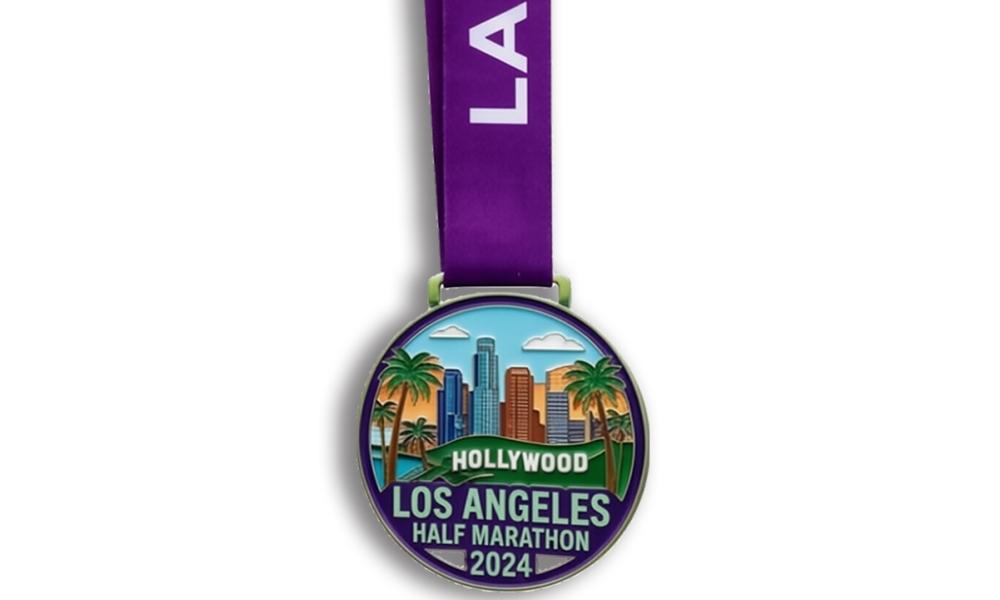
Choose zinc alloy for marathon, half marathon and any event where the medal is a keepable souvenir: it captures fine 3D detail, plates evenly in any finish, supports cut-outs and moving parts, and feels substantial in the hand. Choose iron only for very high-volume, simple designs where cost per unit is the dominant factor — school participation medals, large fun runs, promotional giveaways. Zinc alloy costs roughly 20–35% more than iron at the same size, and in almost every race context that difference buys a visibly better medal.
| Factor | Zinc Alloy | Iron |
|---|---|---|
| Relative cost (same size) | Mid — baseline for racing | 20–35% cheaper |
| Weight / hand feel | Substantial, premium | Lighter, thinner feel |
| Detail capture | Excellent — fine lines, small text | Moderate — details merge when small |
| 3D sculpted relief | Yes, deep and clean | Limited; shallow relief only |
| Cut-outs / hollow shapes | Yes, reliably | Difficult, prone to distortion |
| Plating quality | Even, wide finish range | Acceptable; less consistent on fine detail |
| Dual-tone / specialty finishes | Yes | Usually impractical |
| Moving parts (spinner centers) | Yes | Not practical |
| Mold cost | Standard | Lower |
| Corrosion resistance | Good with anti-oxidation coat | Requires plating; prone to rust if coating fails |
| Best for | Marathons, championships, keepsake awards | High-volume simple participation medals |
Read that table one more time and notice something: iron's advantages are all on the cost side, and zinc alloy's advantages are all on the product side. That's the whole trade-off. Every remaining section is about where that trade-off lands for your specific event.
Ask a dozen medal factories what material they'd recommend for a marathon finisher medal, and most will say zinc alloy without hesitation. There's a reason it's become the default for running events worldwide — it's the only common medal material that combines four things at an affordable price:
The practical summary: if your event is a race people train months for, zinc alloy is the material that does justice to it. We cast the overwhelming majority of our marathon and club medals in zinc alloy, and the designs that come out best — deep relief, cut-out course maps, antique-gold plaques — generally aren't possible in any other material at this price point.
Iron deserves a fair hearing, and there are real situations where it's the right call:
Where iron gets misused is when a buyer applies it to a design that needs detail. Iron medals have thinner profiles and shallower relief capability, so fine text fills, delicate line work merges, and thin cut-outs distort. We've had clients come to us with discarded iron samples where a sponsor's logo had turned to a blur — the design called for zinc alloy and the material didn't get a vote.
One more iron-specific caveat: corrosion. Iron medals depend entirely on their plating for protection. If the coating is incomplete or thin at edges, moisture exposure — sweat, rain at a finish line, humid storage — can start rust. Zinc alloy is intrinsically more forgiving, and with an anti-oxidation protective coat it holds up well over years of display on a wall.
Most buyers think of material as a weight and cost question. In practice, the biggest difference shows up at the plating stage, and it shows up visibly.
Zinc alloy's casting surface is smooth and dimensionally consistent, which means plating deposits evenly across the whole face. Fine edges stay crisp, recesses stay clean, and an antique finish creates genuine depth rather than a uniform dark wash. Iron's surface behavior is less predictable, particularly on sharper geometries — plating can build unevenly on edges, and the resulting medal looks harsher under raking light.
This is also why specialty finishes cluster around zinc alloy. Dual-tone plating — shiny gold recessed with antique gold, say — requires masking and a second plating pass, and it only looks intentional when the underlying surface is precise. Same story for matte and gun-black finishes, which expose every surface imperfection. Zinc alloy gives the finisher something to work with.
If you take one technical point from this article, take this one: the material determines what your finish can look like. Plating doesn't fix a casting surface — it amplifies it.
Designers work in vector software where a 0.3mm line is a 0.3mm line. Casting is a physical process with real minimums, and those minimums differ by material.
| Design Element | Zinc Alloy | Iron |
|---|---|---|
| Smallest legible text height | ~1.5mm and below | ~2.5mm before it fogs |
| Minimum line width | ~0.4mm | ~0.8mm |
| Relief depth for 3D work | Deep, layered sculpture | Shallow, flat relief |
| Course maps / city skylines | Renders well | Details close up |
| Intricate sponsor logos | Reproduces accurately | Needs simplification |
If your design includes a course map with street-level detail, a skyline silhouette, a mascot with texture, or a sponsor logo with fine typography — zinc alloy isn't a preference, it's a requirement. If your design is a laurel wreath with one line of text and a date, iron will do the job at a lower price.
Sit with your designer before you pick a material, not after. It's much cheaper to simplify a design for iron than to discover the mismatch on a finished sample.
Runners are tactile. They pick up the medal at the finish line before they've read a word on it, and the hand feel sets their expectation before the design registers.
A 76mm zinc alloy medal at 3mm thickness with a 3D relief has a satisfying heft — it hangs straight on the ribbon, catches light on its relief, and feels like something that took effort to earn. The equivalent iron medal is lighter and thinner, and for a full marathon finisher who just ran 26.2 miles, that lightness reads as cheap. It's unfair to the material, since iron is a legitimate option, but it's the perception you're managing.
That perception has a measurable consequence, by the way. Finisher medals are the single most photographed item of a race. Heavy, detailed medals photograph better on social media — the relief catches light and the medal reads as substantial in a hand-held shot. Lighter medals can look flat in the same photos. If event registration for next year depends partly on how this year's medal looks online, the material choice is a marketing decision, not just a procurement one.
Race medals have two lives: the race itself and the wall (or drawer) afterwards. Durability matters across both.
Brass is the premium tier, typically 1.5 to 2 times the cost of zinc alloy at the same size. It's noticeably heavier, warmer in tone, and takes a mirror polish that looks genuinely luxurious. Where it earns its price:
For a mass-participation race, brass is usually money you could spend better elsewhere — a 3-inch zinc alloy medal with deep 3D relief and a sublimated ribbon reads as more impressive to a runner than a flatter brass piece. We generally steer race organizers away from brass unless the medal is for a small elite set.
Stainless steel is the newer option in the medal world, and it suits a specific aesthetic: clean, modern, understated. Brands and tech-forward events use it because it photographs like a product rather than an award. It's corrosion resistant by nature, which is its real technical advantage.
What it doesn't do well: deep 3D relief, multi-color enamel, and warm classic finishes. Stainless steel medals tend to be flatter, more graphic, often laser-etched or printed rather than enameled. If your event identity is minimal and contemporary, that's an asset. If you want a collectible, dimensional, antique-gold marathon medal, it's the wrong tool.
| Event Type | Recommended Material | Why |
|---|---|---|
| 5K / fun run (high volume, simple design) | Zinc alloy or iron | Zinc if the medal is a keepsake; iron if purely cost-driven |
| 10K race | Zinc alloy | Detail and plating quality expected at this level |
| Half marathon | Zinc alloy, 76mm, 3mm | The category standard; runners compare across races |
| Full marathon finisher | Zinc alloy, 76–89mm, deep relief | 26.2 miles deserves a dimensional medal |
| Race series (multi-distance) | Zinc alloy, one body, varied finishes | Consistent look, one mold, collectible set |
| School sports day | Iron or zinc alloy | Iron for volume and simple crest designs |
| Kids' race | Zinc alloy, glow or bright soft enamel | Durability and color matter; kids keep them |
| Sports club championship | Zinc alloy | Club crests and sport-specific art need detail |
| Corporate award / long service | Brass or premium zinc alloy | Formality and weight convey recognition |
| Commemorative / boxed set | Brass | Presentation in a case changes expectations |
Medals are skin-contact items worn around the neck, and some events hand them to children. That makes material compliance a real topic, not paperwork theater.
For sales into the US and EU, expect:
Every medal we ship is RoHS and CE certified, and the plant has passed audits for Disney and Universal Studios — audits that examine chemical controls and traceability, not just appearance. If you're supplying medals to a school district or a children's event, ask specifically about nickel release testing and confirm the plating spec in writing. Any factory that quotes those numbers quickly is a factory that has done this before.
Zinc alloy, for essentially every marathon and half marathon. It holds fine detail, supports deep 3D relief and cut-outs, plates evenly in any finish, and feels substantial in the hand. Iron is 20–35% cheaper but limits you to simple, shallow designs — a mismatch for a medal that represents months of training.
Roughly 20–35% more per unit at the same size, depending on design complexity and quantity. At 1,000 medals that difference is often a few hundred dollars across the whole project — a small percentage of total event spend for a noticeably better product. Larger sizes and deeper 3D work widen the gap slightly.
They can, because iron depends entirely on its plating for corrosion protection. If the coating is thin or incomplete at the edges, exposure to sweat, rain or humid storage can start rust. Zinc alloy is intrinsically more resistant, and with an anti-oxidation protective coat both materials perform well over years of display.
Only shallow relief. Deep sculptural work, layered 3D figures and detailed landmarks require zinc alloy's casting characteristics. If your design depends on dimension — a mascot, a city skyline, a sculpted course map — specify zinc alloy from the start rather than discovering the limitation on a finished sample.
Zinc alloy when the medal is meant to be kept, iron when volume and budget dominate and the design is simple. For events involving children, insist on nickel-free plating and ask for nickel release test documentation. Bright soft enamel colors work equally well in both materials.
Brass is the premium option at 1.5–2x zinc alloy cost — right for corporate recognition and boxed commemorative pieces, usually unnecessary for mass-participation races. Stainless steel suits clean, modern, graphic designs, but it doesn't support deep 3D relief or warm classic finishes. For most running events, zinc alloy remains the sweet spot.
Yes, and for larger programs we often recommend exactly that: strike one sample in each material and hold them side by side under daylight. The difference in hand feel and detail is apparent within seconds, and it settles internal debates faster than any spec sheet. Send us your design and we'll quote both options.
Now you know the real trade-off in zinc alloy vs iron medals — and why the answer changes if your design includes a course map, a mascot or fine sponsor typography. If you'd like us to look at your artwork and tell you honestly which material serves it, send it over. We'll quote both zinc alloy and iron with the full cost difference itemized, and free design work is included either way.
Shenzhen Vistarts Craft Co., Ltd. has been casting custom medals since 2011 at our own ISO9001-certified plant — over 10,000 square meters, 5 production lines, 50+ machines, 150+ employees, 20+ engineers and 20+ designers who work alongside the production floor and know what each material can and can't do. The factory has passed audits for Disney and Universal Studios, and our medals have supported programs at the Paris Olympics, the Qatar World Cup and major marathon events. We hold 1,000+ custom medal designs — spinning, 3D, round, square, custom-shaped, glow-in-the-dark — and every medal ships RoHS and CE certified, with nickel-free plating options available. If bulk production doesn't match your approved sample, you get a full refund, in writing.
Send Sean your design for a material recommendation and quote:
WhatsApp / Phone: +86 181 2379 9506
Email: sean@vistarts.net
Website: https://www.vistarts.com/
Tell us your race and what the medal needs to say. We'll tell you what to make it from — and if iron genuinely suits your event, we'll say so and save you the money.

58 South Union Road, South Union Community, Shenzhen, Guangdong, China