View:86113Time:2026.10.19
Medal size looks like a design preference. It isn't. It's a cost decision, a comfort decision, and — more than most race directors expect — a perceived-value decision that runners make in about two seconds at the finish line. Pick too small and a marathon finisher feels shortchanged after 26.2 miles. Pick too large and you're paying for metal nobody notices, or hanging a weight around a ten-year-old's neck that they'll take off before the photo.
We cut medals from 45mm to 120mm every week, so here's the size guide we actually use with race directors: standard dimensions by distance, the thickness spec that matters more than diameter, ribbon widths that match, and the cost curve so you can see exactly what each size step buys you.
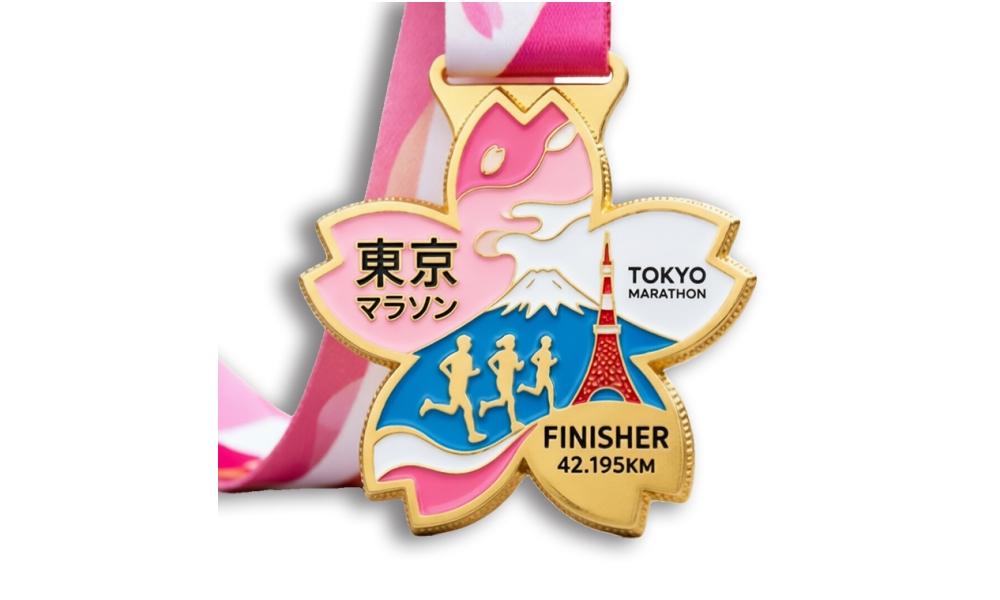
Standard custom medal sizes are 50–60mm for kids' races and fun runs, 60mm for 5K, 65–70mm for 10K, 76mm (3") for half and full marathons, and 89–102mm for flagship or anniversary marathons, at thicknesses of 2.5mm to 4mm. The 76mm size is the industry default for marathon finishers because it's large enough to carry event name, date and artwork legibly while staying affordable at volume. If your budget allows one upgrade, add thickness before diameter.
Three things happen when a runner receives a medal, and size affects all three.
First, the hand. A medal is picked up before it's read. Weight and diameter register as value before any design detail does. This is why a 76mm medal at 3.5mm feels more expensive than an 85mm medal at 2.5mm — the density of the object communicates more than its footprint.
Second, the photo. Most medals are consumed as images. A larger medal fills more of a phone photo, shows relief more clearly, and holds its presence when the image is compressed for social media. Small medals disappear into a frame, especially in a group shot with several finishers.
Third, the cost. Price scales with surface area and material volume, roughly with the square of the diameter. Going from 60mm to 76mm is a 60% increase in area, not a 27% one — which is why the jump from a 10K medal to a marathon medal is more expensive than the millimetre difference suggests.
Size also has a practical ceiling that has nothing to do with budget. A medal that's too heavy for its ribbon pulls at the neck, hangs crooked, and gets removed. That matters most for children's events, where a 90mm solid medal is simply the wrong object.
The three-inch marathon medal is a convention, not a rule, but conventions in this industry tend to have practical roots. At 76mm:
Where the standard breaks: flagship marathons with big budgets go to 89mm or 102mm because the medal is part of the event's identity. Trail and ultra events sometimes go smaller but thicker, since a compact, heavy medal suits the culture better than a large thin one. Neither is wrong — both are deliberate choices rather than defaults.
| Event Type | Diameter | Thickness | Shape | Notes |
|---|---|---|---|---|
| Kids' race (under 12) | 45–55mm | 2.0–2.5mm | Round or simple custom | Light enough to wear; bright enamel or glow |
| School sports day | 50–60mm | 2.0–2.5mm | Round | Volume matters; simple crest artwork |
| Fun run / charity walk | 55–60mm | 2.5mm | Round | Keep cost low; ribbon carries the branding |
| 5K | 60mm | 2.5mm | Round | High volume, simple design, strong color |
| 10K | 65–70mm | 2.5–3.0mm | Round or custom | Room for a course map or city silhouette |
| Half marathon | 76mm | 3.0mm | Round or custom | The category standard; runners compare across races |
| Full marathon | 76–89mm | 3.0–3.5mm | Round or custom | 3" minimum; 3.5" for established races |
| Flagship / anniversary marathon | 89–102mm | 3.5–4.5mm | Custom, cut-out, multi-layer | Signature piece; often with 3D relief or spinner |
| Trail / ultra | 70–80mm | 3.5–4.0mm | Custom, rugged | Compact but heavy reads as serious |
| Corporate / recognition award | 60–80mm | 3.0–4.0mm | Round, plaque-style | Brass or premium plating; presentation box |
Two practical notes on reading this table. First, these are starting points, not limits — a 5K with 4,000 participants and a strong brand can absolutely justify a 70mm medal. Second, consistency across your event matters more than hitting a spec: if your 10K medal is 70mm and your half is 76mm, runners will read that difference as intentional status. If they're 68mm and 71mm, it reads as an accident.
Diameter gets all the attention, but thickness is where the "this feels expensive" impression is made. A 2.5mm medal has a thin, almost coin-like edge. At 3.5mm, the edge reads as a solid object, the relief has depth behind it, and the medal hangs with weight.
| Thickness | Impression | Best For |
|---|---|---|
| 2.0mm | Light, economy | Kids' medals, participation awards, tight budgets |
| 2.5mm | Standard, adequate | 5K, fun runs, school events |
| 3.0mm | Solid, expected at race level | 10K, half marathon |
| 3.5mm | Premium, noticeable in hand | Full marathon, flagship events |
| 4.0mm+ | Heavy, commemorative | Anniversary pieces, ultra medals, awards |
Here's the trade-off worth understanding: increasing thickness raises cost roughly linearly with material volume, while increasing diameter raises it with area. At the same added cost, thickness usually delivers a bigger perceived improvement — especially on medals that will be held and photographed rather than compared side by side.
One caveat: if your design has deep 3D relief, thickness isn't optional. Deep sculpture needs metal behind the high points, so a 76mm medal with a sculpted landmark may need 3.5mm minimum to avoid weak spots and distortion. Ask your factory to confirm the minimum for your specific relief.
Shape and hole placement are where "big" medals quietly fail.
On shape: round is the most cost-efficient and the most forgiving for artwork. Custom shapes — a state outline, a shoe, a mountain ridge — add tooling cost and can create thin points that bend or chip. If you want a custom shape, thicken the narrowest parts during design rather than discovering the problem in production.
On hole placement: the hanging hole decides how the medal sits. Placed high, the medal hangs upright and photographs flat and square. Placed low, it tips forward, which can look dynamic — or can look like a manufacturing error. For a symmetrical design, center the hole at the top of the mass, not the top of the bounding box. For asymmetrical custom shapes, the hole often needs to sit off-center to keep the medal level.
This is a two-minute conversation with your factory that prevents a very common complaint: "it hangs crooked." Ask for a rendering that shows the medal hanging from a ribbon, not just the face artwork.
Nobody thinks about this until they see a child take a medal off mid-ceremony.
As a rough guide, a 76mm zinc alloy medal at 3mm weighs somewhere in the region of 70–110 grams depending on relief and cut-outs. That's comfortable for an adult over a race morning and an evening of photos. At 102mm and 4.5mm, you're into the 180–250 gram range — fine for a presentation, less fine for a 10-year-old wearing it for four hours.
If you're unsure, ask for two sample weights before production. Factories can tell you the approximate gram weight per size and thickness for a given design, and it's a better decision input than guessing from a rendering.
Using a 76mm soft-enamel zinc alloy medal at 1,000 pieces as the index of 100, here's how size alone moves the unit price. These indices isolate size — same design complexity, same finish, same quantity.
| Diameter | Relative Surface Area | Cost Index | Approx. Unit Price at 1,000 pcs |
|---|---|---|---|
| 50mm (2") | 43% | ~65 | $0.85 – $1.05 |
| 60mm (2.4") | 62% | ~78 | $1.00 – $1.25 |
| 65mm (2.6") | 73% | ~85 | $1.10 – $1.35 |
| 76mm (3") | 100% | 100 | $1.30 – $1.60 |
| 89mm (3.5") | 137% | ~120 | $1.55 – $1.95 |
| 102mm (4") | 180% | ~145 | $1.90 – $2.35 |
Read the middle column carefully: 102mm has 80% more surface area than 76mm but only costs about 45% more per unit. That gap exists because setup, plating labor and handling don't scale with area the way material does. Which means large medals are better value per square centimetre than small ones — the reason flagship races can justify going big.
The flip side: at 10,000 pieces, that 45% difference is real money. Which brings back the central trade-off — if your budget is fixed, thickness usually beats diameter for perceived quality, and ribbon quality beats both.
A 76mm medal on a 20mm ribbon looks like a sign hanging from a shoelace. Proportion matters, and it costs very little to get right.
| Medal Size | Recommended Ribbon Width | Notes |
|---|---|---|
| 45–55mm | 20mm (0.8") | Kids' medals; soft ribbon |
| 60–65mm | 20–25mm (0.8–1") | 5K, 10K standard |
| 70–76mm | 25mm (1") | The most common race combination |
| 89mm | 25–38mm (1–1.5") | Larger medals need visual weight below |
| 102mm+ | 38mm (1.5") | Flagship pieces; consider a wider weave ribbon |
Two ribbon details worth specifying alongside size: a safety breakaway clasp (especially for children and large fields), and heat-sealed ribbon ends so they don't fray by the time runners reach the finish. Both are inexpensive and both are the kind of thing runners notice only when they're missing.
If you run multiple distances, size becomes a communication tool. Two approaches work:
Equal sizing. All distances get the same diameter and thickness, differentiated by design and color. This signals that every finisher's achievement is equally respected — a good fit for community races where the 5K is as important as the half.
Hierarchical sizing. 5K at 60mm, 10K at 65mm, half at 76mm, full at 89mm. This creates a visible ladder of achievement and gives runners a reason to step up a distance. It's common in big-city race weekends and works well when the full marathon is the marquee event.
What doesn't work is accidental sizing — differences of two or three millimetres that read as inconsistency rather than intent. Pick one approach, apply it across the series, and keep the design language identical so the set still looks like a family.
76mm (3 inches) is the standard for half and full marathon finisher medals, typically at 3mm thickness. Established races often go to 89mm (3.5"), and flagship or anniversary marathons to 102mm (4"). Anything below 70mm for a full marathon tends to feel small to runners who have other medals to compare against.
60mm (2.4") at 2.5mm thickness is the practical standard for a 5K, though high-volume fun runs often use 55–60mm to control cost. If the 5K is part of a series with longer distances, match its design language and use color or a distance plate to differentiate rather than size alone.
No. Beyond about 89mm, the gains in perceived value flatten while cost and weight keep rising. A 76mm medal at 3.5mm with a full-color sublimated ribbon usually reads as more premium than a 102mm medal at 2.5mm with a basic ribbon. Proportion, thickness and finish matter more than raw diameter.
2.5mm for 5K and school events, 3.0mm for 10K and half marathons, 3.5mm for full marathons and flagship races, and 4mm+ for commemorative or heavy 3D pieces. If your design has deep sculpted relief, confirm the minimum thickness with your factory — deep relief needs metal behind the high points.
45–55mm at 2.0–2.5mm thickness. The goal is something a child will actually keep wearing: light enough to be comfortable, bright enough to be exciting, and durable enough to survive being carried around for a week. Glow-in-the-dark enamel is a strong choice for this age group.
Yes, and hierarchical sizing — 60mm for 5K up to 89mm for the full marathon — is a common way to signal achievement levels. Just keep the design language consistent so the set reads as a family, and make each size difference large enough to be obviously intentional rather than accidental.
Roughly in proportion to surface area, but not perfectly. Going from 76mm to 89mm adds about 20% to unit cost despite 37% more area, because setup and labor don't scale with size the way material does. Going from 76mm to 102mm adds around 45%. At high volumes those percentages become significant budget lines.
If you're still deciding between 76mm and 89mm, or whether to spend the difference on thickness instead of diameter, send us your event details and we'll give you a straight recommendation — including the gram weight, the ribbon width that matches, and the price difference between the two options at your quantity. Free design work included, and a quote inside 24 hours.
Shenzhen Vistarts Craft Co., Ltd. has been producing custom medals since 2011 at our own ISO9001-certified plant — more than 10,000 square meters, 5 production lines, 50+ machines, 150+ employees, 20+ engineers and 20+ designers working alongside the production floor. The factory has passed audits for Disney and Universal Studios, and our medals have supported programs at the Paris Olympics, the Qatar World Cup and major marathon events. We produce every size from 45mm kids' medals to 120mm commemorative pieces, with 1,000+ designs on file — spinning, 3D, round, square, custom-shaped, glow-in-the-dark — all RoHS and CE certified. If bulk production doesn't match your approved sample, you get a full refund. In writing.
Send Sean your distance and field size for a size recommendation:
WhatsApp / Phone: +86 181 2379 9506
Email: sean@vistarts.net
Website: https://www.vistarts.com/
Tell us the race and how many runners you expect. We'll tell you the size that fits the achievement, the budget and the neck it's going around.

58 South Union Road, South Union Community, Shenzhen, Guangdong, China