View:92055Time:2026.10.31
This is the question that decides more medal budgets than any other, and it's usually answered badly — either "hard enamel is better" or "soft enamel is cheaper," both of which are half-true and expensive to act on. We run both finishes on the same production floor, on the same dies, for the same customers, and the correct choice depends on four things: how the medal will be handled, how small your text is, how many colours you need, and whether the surface has to be clean enough to engrave on later.
Here's the honest comparison: the manufacturing difference, why hard enamel costs 15–25% more, where each one actually fails, the minimum feature sizes that determine whether your design survives, and a decision table you can hand to a committee.

Choose soft enamel for race finisher medals, school and club awards, and any order where colour impact matters more than a mirror-smooth surface — it's 15–25% cheaper, holds brighter colours, and hides minor surface imperfections. Choose hard enamel for flagship races, commemorative and corporate pieces, and designs that will be engraved or handled constantly, because the polished flush surface reads as jewellery and wipes clean. Both last decades. The difference is surface, not lifespan.
| Soft Enamel | Hard Enamel | |
|---|---|---|
| Surface | Enamel recessed; metal lines stand proud | Ground flat and polished; one continuous surface |
| Texture | Tactile, slightly ridged | Smooth, glass-like |
| Colour brightness | Higher — deeper, more saturated | Slightly softer; polishing dulls the top layer |
| Relative cost | Baseline | +15–25% |
| Best for | Race finishers, schools, clubs, volume orders | Flagship, commemorative, corporate, retail |
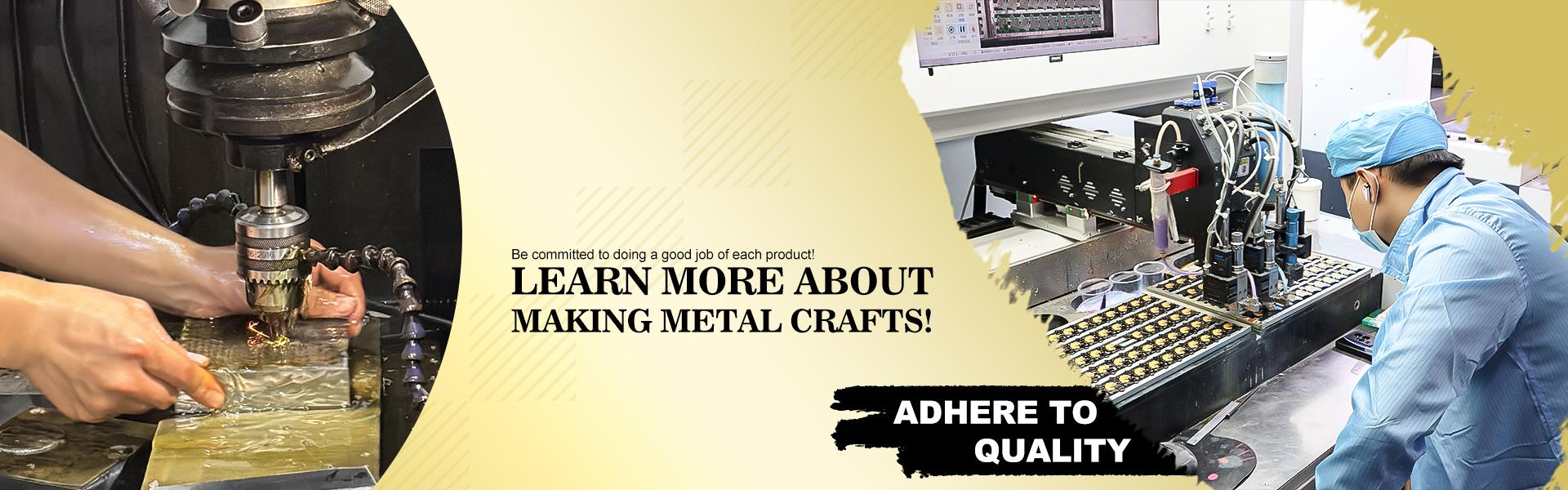
Both finishes start identically. A die strikes or casts the medal body with recessed channels for each colour, separated by raised metal lines. Enamel paste is hand-filled into those channels, colour by colour, then cured in an oven. Up to this point, soft and hard enamel medals are the same object.
Then they diverge. A soft enamel medal is finished here: the enamel sits slightly below the metal ridges, the surface keeps its relief, and the piece goes to assembly. A hard enamel medal goes through additional passes — more enamel (because enamel shrinks when cured, so the channels have to be over-filled), curing, then grinding the entire face flat on a lapping wheel, then polishing. Now the metal lines and the enamel are one continuous plane.
That's the whole difference: hard enamel is soft enamel that has been over-filled, ground flat and polished. Everything else — the price gap, the durability behaviour, the design constraints — follows from that single extra operation.
Soft enamel, step by step:
Hard enamel, step by step:
The grinding step is where rejects come from. Polishing reveals everything: a bubble that sat below the surface in a soft enamel piece becomes an open pit in a hard enamel piece; a channel filled 0.05mm short becomes a visible dip; a thin metal separator gets ground away entirely, merging two colours. This is why hard enamel has a higher reject rate — typically 3–6% versus 1–2% on soft — and why that reject rate is already inside the price you're quoted.
Buyers often assume the premium is a "premium finish" markup. It's labour and yield:
What doesn't change: the mold, the metal, the plating chemistry, the ribbon, or the artwork setup. So if a supplier quotes you 60% more for hard enamel, ask which of those four cost drivers explains it. There isn't one.
| Point | Soft Enamel | Hard Enamel |
|---|---|---|
| Surface profile | Recessed enamel, raised metal lines | Flush, single plane |
| Hand feel | Tactile, grips slightly | Smooth, cool, glass-like |
| Colour saturation | Stronger; more depth | Slightly muted after polishing |
| Photograph appearance | Reads as "sporty", strong at distance | Reads as "premium", strong in close-ups |
| Scratch behaviour | Scratches hit the metal ridges; enamel protected | Surface scratches are visible but can be re-polished |
| Chip behaviour | Enamel can chip out of deep narrow channels | Chips at edges are harder to repair |
| Cleanability | Dirt collects in the recesses | Wipes clean in one pass |
| Engraving on face | Not practical — uneven surface | Works well; flat surface takes clean laser marks |
| Minimum metal line width | 0.25–0.3mm holds reliably | 0.4mm minimum; thinner lines get polished away |
| Maximum colours, practical | 6–8 before cost climbs steeply | 4–6; each extra pass raises reject risk |
| Relative cost | Baseline | +15–25% |
| Added lead time | — | +2–4 working days |
"Hard enamel is more durable" is the most repeated claim in this category and the least examined. Both finishes survive normal use for decades. What differs is the failure mode.
Soft enamel fails at the edges of narrow channels. Because the enamel sits in a recess and is held by the channel walls, a hard impact can pop a chip of enamel out of a deep, narrow channel — think of a 0.4mm line holding a thin sliver of colour. The metal ridges protect the broad areas, which is why soft enamel medals from the 1980s still look fine: the design was built with wide channels. If your design is mostly broad colour fields, soft enamel holds up better than its reputation suggests.
Hard enamel fails at the surface. A flush polished face shows scratches, and a drop onto concrete can chip at the rim where the enamel meets the edge. The compensating advantage: a scratched hard enamel medal can often be re-polished, and it never accumulates dirt in recesses, so it looks newer for longer in humid storage or on a keyring.
The practical conclusion for medals that hang on a wall or sit in a drawer: durability is not the deciding factor. Both are fine. Choose on surface appearance, cleanability, and whether you need to engrave.
For medals worn against skin for hours at a time — a marathon finisher medal on a sweaty neck — add this: both finishes are nickel-safe if the plating is specified correctly (nickel release under EN 1811 / REACH at 0.5 µg/cm²/week). The finish doesn't change that; the plating chemistry does.
This is where designs die, and it's rarely discussed before the sample stage.
| Feature | Soft Enamel | Hard Enamel |
|---|---|---|
| Minimum metal line (separator) | 0.25–0.3mm | 0.4mm |
| Minimum enamel channel width | 0.3mm | 0.35mm |
| Minimum cap height for text | ~1.5mm | ~1.8mm |
| Minimum stroke width in lettering | 0.3mm | 0.4mm |
| Fine detail below these limits | Falls back to UV print | Falls back to UV print or laser |
Counter-intuitively, soft enamel holds finer detail than hard enamel, because nothing grinds the thin metal separators down. A design with 0.3mm separators can be made in soft enamel and will fail in hard enamel — the polishing step erodes those lines and the colours bleed into each other. If your artwork has fine linework, either go soft enamel or thicken the lines to 0.4mm for hard.
And if the detail is finer than either process allows — a detailed building facade, a map, a photograph — the correct answer is UV printing with an epoxy or hard-coat dome, not more enamel colours. Enamel is a flat-colour process. It always has been.
Soft enamel makes a design look bolder. The raised metal lines catch light and create a dark outline around each colour, so the whole piece reads like stained glass. That outline is a free graphic device: it separates colours at a distance, which is why soft enamel works so well for race medals photographed at arm's length and hanging on a wall.
Hard enamel makes a design look expensive. The continuous polished plane removes the outlines and lets the metal and enamel sit in one surface — closer to cloisonné, closer to jewellery. It rewards simple, confident shapes and punishes fussy ones, because every element is now in the same plane competing for attention.
One design consequence people don't expect: hard enamel changes the perceived colour of thin metal details. Because the lines are polished flush, gold lines on a dark background become brighter and more continuous in hard enamel, while in soft enamel they read as ridges with shadow. If your design depends on thin gold rule lines creating a pattern, hard enamel delivers it more cleanly — provided the lines are 0.4mm or thicker.
Same 60mm zinc alloy medal, same die, same plating, printed ribbon, ex-works Shenzhen. The only variable is the enamel finish.
| Quantity | Soft Enamel | Hard Enamel | Difference |
|---|---|---|---|
| 100–499 | $1.90 – $2.40 | $2.30 – $2.90 | +$0.40 – $0.50 |
| 500–999 | $1.70 – $2.10 | $2.05 – $2.55 | +$0.35 – $0.45 |
| 1,000–2,999 | $1.30 – $1.60 | $1.60 – $2.00 | +$0.30 – $0.40 |
| 3,000+ | From $1.15 | From $1.45 | +$0.30 |
Read the pattern, not just the numbers: the absolute gap shrinks as volume rises. At 100 pieces, hard enamel costs about 20% more; at 3,000 pieces, about 26% — but in absolute terms it's 30 cents instead of 45. On a 5,000-piece order, that premium is roughly $1,500. Which is either trivial or decisive depending on what the medal is for, and that's the entire point.
Useful framing for a committee: $0.35 per medal is about 20% of the unit cost but under 1% of a race entry fee. If the medal is the thing participants keep, the upgrade math usually favours hard enamel for flagship events and favours soft enamel for volume events where the same money is better spent on size, thickness or a printed ribbon.
| Medal Type | Recommended | Why |
|---|---|---|
| 5K / 10K finisher medal (1,000–5,000 pcs) | Soft enamel | Colour impact at distance; budget better spent on size |
| Marathon finisher, mid-size race | Soft enamel | Strong colour, holds up in broad fields, cost per unit matters |
| Flagship marathon / anniversary piece | Hard enamel | Keepsake object; close-up photos; premium perception |
| School sports day (500+ pcs) | Soft enamel | Bright colours for children; durable enough; budget-sensitive |
| Club season awards (recurring) | Soft enamel | Annual reorder; cost compounds every season |
| Corporate / commemorative award | Hard enamel | Handled by executives; engraved names on a flat face |
| Retail / sold in a gift box | Hard enamel | Must survive shelf handling and look flawless in the box |
| Medal with engraved names on the face | Hard enamel | Laser engraving needs a flat surface |
| Design with fine linework under 0.35mm | Soft enamel | Hard enamel polishing destroys thin separators |
| Medal with 7+ enamel colours | Soft enamel | Hard enamel reject rate climbs with each fill pass |
Four combinations that solve specific problems:
This is the single most common substitution in the medal trade, and it's worth being blunt about.
Some suppliers describe a soft enamel medal with an epoxy dome as "hard enamel." It isn't. The surface is glossy and smooth to the touch, which is enough to pass a casual inspection, but underneath the epoxy the enamel is still recessed and the metal lines still stand proud. You can detect it in three ways: look at the medal edge-on (a true hard enamel face is one plane; an epoxy dome has a visible curvature), look for the metal lines under raking light (they'll show as ridges under resin), and ask for the production photo of the lapping step — a hard enamel order has one.
The honest vocabulary in this industry: soft enamel, hard enamel (also called cloisonné-style or polished enamel), imitation hard enamel (a thicker fill, sometimes ground but not fully polished), and epoxy-domed soft enamel. If a quote says "hard enamel" at soft enamel pricing, ask which of those four you're actually buying — in writing, on the spec sheet.
1. Specifying hard enamel to mean "better quality." It means a different surface. On a 10,000-piece race order, the premium may buy less perceived value than spending the same money on 3mm thickness and a woven ribbon.
2. Designing 0.3mm separators and ordering hard enamel. The polishing step erases them and the colours merge. This is caught at the sample stage if you're lucky, and at delivery if you're not.
3. Approving a soft enamel sample for a hard enamel order. They are different products. The sample must be produced in the finish you're buying — a soft enamel sample tells you nothing about polishing yield.
4. Not writing the finish into the contract. "Enamel" alone is ambiguous. Write "hard enamel, polished flush" or "soft enamel, recessed" on the spec sheet and on the purchase order.
5. Adding colours to hit a design idea. Each colour is a hand fill. Eight colours on a hard enamel medal is a reject-rate problem, not a design choice. If you need photographic detail, the answer is print.
6. Forgetting the back. On a hard enamel medal the back is usually left as raw metal or plated metal with a brushed finish — check the spec. On soft enamel, the back is where engraving goes, and a recessed or uneven back makes laser engraving look poor.
Not better — different. Hard enamel gives a flush, polished, jewellery-like surface that wipes clean and accepts engraving, at 15–25% higher cost and 2–4 extra days. Soft enamel gives brighter colours, finer detail capability and lower cost, with a tactile recessed surface. For volume race medals, soft enamel is usually the better commercial choice; for flagship and commemorative pieces, hard enamel is.
About 15–25% more than soft enamel on the same medal: roughly $0.40–0.50 extra per piece at 100–499 units, $0.30–0.40 at 1,000–2,999. On a 60mm zinc alloy medal at 1,000 pieces, soft enamel runs $1.30–$1.60 and hard enamel $1.60–$2.00.
Not meaningfully. Both finishes last decades in normal use; they fail differently. Soft enamel can chip out of narrow channels on hard impact but is protected by raised metal ridges. Hard enamel resists dirt and can be re-polished, but shows surface scratches and can chip at the rim. For a medal that hangs on a wall, lifespan is not the deciding factor.
On the back, yes — laser engraving works on the plated metal back. On the face, no: the recessed enamel and raised metal lines make a clean mark impossible. If the name must appear on the front, specify hard enamel, which gives a flat plane for laser engraving.
Because the polishing step removes the top layer of enamel and leaves a slightly matte-to-gloss transition, and because the raised metal ridges that create contrast in soft enamel are gone. Hard enamel reads richer and more solid, soft enamel reads brighter and more graphic. If maximum colour punch is the goal, stay with soft enamel.
You can, but the economics deteriorate. Each colour is a separate hand-fill pass, and every extra pass raises the risk of pits and bubbles that polishing will expose. Four to six colours is the practical range; above that, soft enamel or UV printing is the better route.
Ask for the lapping/polishing step in the production photos, check the medal edge-on for a single flat plane (an epoxy dome curves), and look at the metal lines under raking light — ridges mean soft enamel under resin. Put "hard enamel, polished flush" on the spec sheet and the purchase order, and approve a sample made in the actual finish.
Send us the artwork — even a rough sketch — plus your quantity and event type, and we'll tell you which finish your design can actually be manufactured in, what the minimum line widths need to be, and the price difference at your volume. If soft enamel serves your event better, we'll say so, even though hard enamel costs more. Free design review, quote inside 24 hours.
Shenzhen Vistarts Craft Co., Ltd. has been producing custom medals since 2011 in our own ISO9001-certified factory — over 10,000 square meters, 5 production lines, 50+ machines, 150+ employees, 20+ engineers and a 20-person design team working beside the production floor. The plant has passed audits for Disney and Universal Studios, and our medals have supported the Paris Olympics, the Qatar World Cup and major marathon events. We run both finishes in-house — soft, hard, epoxy-domed, die-struck and UV-printed — across 1,000+ designs, all RoHS and CE compliant, with a full refund if bulk production doesn't match your approved sample.
Send Sean your artwork and quantity:
WhatsApp / Phone: +86 181 2379 9506
Email: sean@vistarts.net
Website: https://www.vistarts.com/
A last piece of advice from the sample bench: approve the finish in your hand, not on a screen. Photographs flatten the one difference you're paying for — the surface. Hold a soft enamel piece and a hard enamel piece side by side under a window before you sign anything, and the decision takes about four seconds.

58 South Union Road, South Union Community, Shenzhen, Guangdong, China