View:75004Time:2026.11.10
Buyers spend weeks on the medal and ten minutes on the ribbon. Then the medals arrive, and the first complaint is always about the ribbon: too short, too narrow for the medal, the print peeling at the fold, or a jump ring that opened somewhere between the factory and the finish line. We've shipped millions of metres of ribbon alongside our medals, and the failures are almost never mysterious — they come from four unexamined decisions: width, length, print method and hardware.
This guide covers all four with the numbers we actually use: ribbon width matched to medal diameter, length calculated from the wearer rather than guessed, five print methods and what each costs, the hardware that survives a marathon, and the eight specification mistakes that turn a good medal into a bad memory.
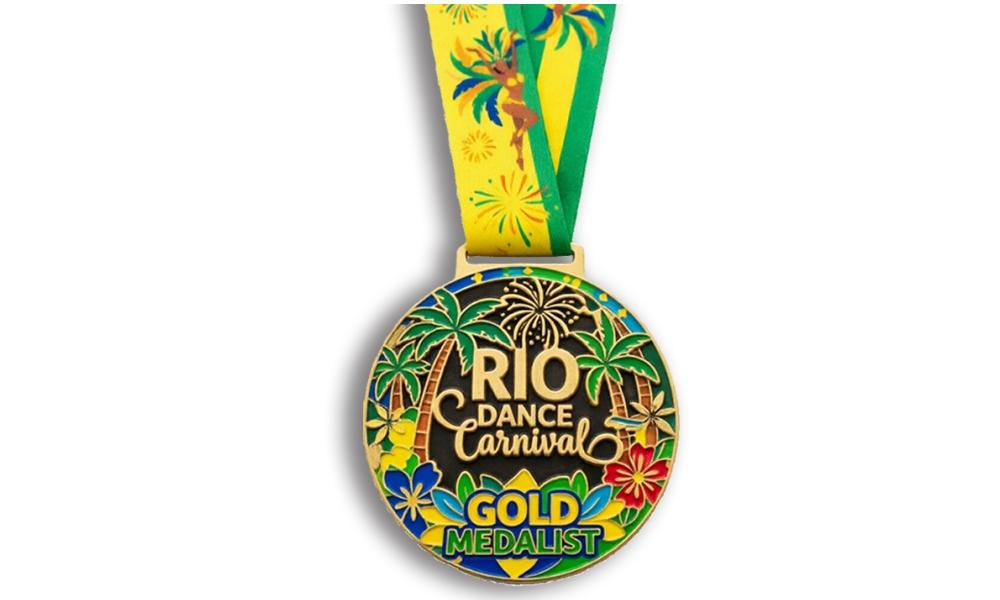
Standard custom medal ribbons are 20mm wide for medals up to 60mm, 25mm for 65–76mm medals, and 38mm for 89mm and larger. Adult length is 90cm total (45cm drop); children's medals run 60–70cm with a breakaway fitting. Polyester satin is the default material, screen printing is the cheapest way to add one or two colours, dye sublimation is the way to add full-colour artwork, and woven jacquard is the premium option at 2–3x the cost. Printed ribbons add $0.25–$0.60 per medal and 5–7 days to production.
| Medal Size | Ribbon Width | Adult Length | Typical Use |
|---|---|---|---|
| 40–50mm | 20mm (0.8") | 65–70cm | Kids' events, schools |
| 50–60mm | 20mm (0.8") | 80–90cm | 5K, 10K, clubs |
| 65–76mm | 25mm (1") | 90cm | Half and full marathon |
| 89mm | 25–38mm (1–1.5") | 90–100cm | Flagship races |
| 102mm+ | 38mm (1.5") | 100cm | Commemorative, oversized |
Three reasons, and all three hit the buyer, not the factory.
It's the part that touches skin. A medal is held for seconds and worn for hours. A stiff, scratchy ribbon with a raw cut end announces cheapness before anyone reads the event name. A soft satin ribbon with a heat-sealed end does the opposite.
It's in every photograph. At a finish line, the medal is the subject and the ribbon is the frame. A 20mm ribbon on an 89mm medal looks like a shoelace holding a dinner plate — the single most common proportion error we see, and the cheapest to fix.
It's the first thing to fail. Jump rings open, crimps slip, printed logos crack at the fold, and ribbons fray from the cut end upward. A medal that falls off at the after-party is remembered as a broken medal, even though the medal itself is fine.
Five components, each specified separately:
Most quotes only mention item one. When you compare suppliers, compare all five — a quote that includes a jump ring, a crimp and a heat-sealed end is not the same product as one that includes "ribbon".
The rule we use in the sample room: the ribbon should be roughly one-third the medal's diameter. A 76mm medal wants 25mm; a 50mm medal wants 20mm; a 102mm medal wants 38mm. Below a third, the medal looks like it's hanging from string. Above a half, the ribbon starts to overpower the medal and the whole assembly gets heavy.
| Medal Diameter | Ideal Ribbon Width | Acceptable Range | Visual Result |
|---|---|---|---|
| 45mm | 20mm | 15–20mm | Balanced; 15mm reads as a children's medal |
| 60mm | 20mm | 20–25mm | 20mm standard, 25mm for a more formal look |
| 76mm | 25mm | 25mm | The classic marathon combination |
| 89mm | 25–38mm | 25–38mm | 25mm works if the medal is thin; 38mm if thick |
| 102mm | 38mm | 38mm | Below 38mm it looks undersized in photos |
Cost reality: moving from 20mm to 25mm adds roughly $0.03–0.06 per metre of ribbon, which on a 90cm ribbon is about three to five cents per medal. Proportion is one of the cheapest quality signals in the entire product.
Ribbon length is normally quoted as total length, but what matters is the drop — the distance from the back of the neck to the top of the medal. A 90cm ribbon, folded over the neck, gives a 45cm drop.
| Wearer | Total Length | Drop | Where the Medal Sits |
|---|---|---|---|
| Age 4–7 (approx. 105–120cm tall) | 60–65cm | 30–32cm | Chest — correct |
| Age 8–12 (approx. 125–145cm) | 70cm | 35cm | Chest — correct |
| Teens and adults | 90cm | 45cm | Mid-chest — correct |
| Adult, over a jacket or hoodie | 100cm | 50cm | Sits over outer layer |
The failure case is easy to picture: a 90cm ribbon on a seven-year-old puts the medal at stomach level, where it swings into everything and looks wrong in every photograph. This is the single most common complaint from school orders, and it costs nothing to fix at the specification stage — just state the wearer's age band.
Two practical notes. One length cannot serve a school from reception to year six; either split the order into two lengths (60cm and 70cm) or accept that the youngest children will be wearing theirs long. And if the medal is heavy — over about 100g — add 5cm to keep the medal off the collarbone; a heavy medal on a short ribbon sits on the throat and gets pulled off within the hour.
Four materials cover 95% of medal orders. Each behaves differently, and the price differences are larger than most buyers expect.
| Material | Feel | Print Quality | Cost Index | Best For |
|---|---|---|---|---|
| Polyester satin | Smooth, slight sheen | Excellent for sublimation | 100 | Races, schools, clubs — the default |
| Grosgrain | Ribbed, matte, firmer | Good for screen print; sublimation looks softer | 110–125 | Premium sports, retro look, heavy medals |
| Woven jacquard | Textured, logo woven in | Best durability; no cracking or peeling | 250–400 | Flagship races, corporate, keepsake |
| rPET / recycled polyester | Same as satin | Excellent | 105–120 | Events with a sustainability claim |
Satin is the workhorse: soft, cheap, takes full-colour sublimation beautifully, and looks good in photographs because of the sheen. Its weakness is that it shows creases and can look inexpensive when thin — specify a minimum weight (we use 150–180 gsm for medals; anything under 120 gsm feels like gift-wrap ribbon).
Grosgrain has a ribbed texture and a matte finish. It feels more substantial in the hand, holds its shape better on heavy medals, and reads as "serious sport" rather than "party". Slightly more expensive and slightly less vivid for photographic printing.
Woven jacquard is the premium route for a woven medal ribbon: the design is woven into the fabric rather than printed on it, so it cannot crack, peel or fade. It's also the only option that survives years of washing and handling. The catch is cost and minimums — usually 500–1,000 metres minimum, 2–3x the price of printed satin, and 15–20 days lead time. For a flagship marathon where the ribbon is part of the identity, it's worth it. For a 300-piece school order, it isn't.
rPET is recycled polyester made from bottles, visually indistinguishable from standard satin, and typically 5–20% more expensive. If your event markets itself as sustainable, this is a cheap and credible way to make the claim physical rather than rhetorical — but check that the supplier can show a certificate, or you're just buying green-coloured ribbon.
Five methods, and the choice is driven by colour count and quantity more than by quality.
| Method | Colours | Cost per Medal (approx.) | Best At | Weakness |
|---|---|---|---|---|
| Plain (no print) | — | $0.15–0.30 | Any quantity | No branding |
| Screen print, 1 colour | 1 | $0.25–0.40 | 500+ pieces | Setup cost per colour |
| Screen print, 2–3 colours | 2–3 | $0.35–0.55 | 1,000+ pieces | Registration drift on fine text |
| Dye sublimation (full colour) | Unlimited | $0.35–0.60 | 100+ pieces | Colours soften on dark ribbon |
| Woven jacquard | 4–6 in the weave | $0.70–1.50 | 500–1,000m minimum | Cost, lead time, minimums |
Screen printing lays a thick ink layer that reads crisply on both satin and grosgrain, and it's the cheapest way to print a single sponsor logo or event name at volume. Each colour needs its own screen and setup, so it stops being economical past three colours.
Dye sublimation prints full-colour artwork by turning the ink into gas that bonds with the polyester fibres. No setup cost, no colour limit, and it handles photographs and gradients. Two limits: it only works on polyester (not cotton or nylon), and on dark ribbons the colours lose punch unless you print a white underbase — which some suppliers skip to save money, leaving muddy artwork.
A detail worth knowing: printed ribbon is usually printed on one side only. If your design will be visible from both sides — and on a medal worn all day, it will — specify double-sided printing, which typically adds 40–60% to the ribbon cost. Many buyers discover this after the first batch.
Ribbon artwork fails for predictable reasons. These rules prevent most of them:
The medal is a solid piece of metal. The failure point is always the connection. Here's what we specify and why:
| Hardware | Spec | Failure Mode | Use |
|---|---|---|---|
| Jump ring | 18–20 gauge, soldered or welded closed | Unsoldered rings open under load | Standard for all medals |
| Crimp / end cap | Metal, crimped twice, or stitched | Single crimp slips on smooth satin | Ribbon-to-ring joint |
| Swivel clip | Metal, 25–30mm | Cheap clips bend at the swivel | Detachable medals, lanyards |
| Safety pin | Stainless, 25mm+ | Pin opens; fabric tear | Rosettes, badges — not medals |
| Breakaway clip | Plastic, releases at 3–5kg | Too-weak clips release during a hug | Children's events |
| Lobster claw | Metal, 12–15mm | Spring weakens with salt/sweat | Premium detachable |
Three specifications that matter more than they look:
Soldered jump rings. A standard jump ring is a coiled wire with a gap. Under a medal's weight plus movement, that gap opens. Soldered or welded rings cost about $0.02 more and eliminate the single most common "my medal fell off" failure.
Double crimping or stitching. The ribbon-to-ring joint is usually a metal crimp. On smooth satin, a single crimp can slide. We crimp twice and add a stitch line on orders above 1,000 pieces; it costs pennies and removes a whole category of complaint.
Heat-sealed ends. A raw-cut ribbon end frays from the first wear. Heat-sealing melts the edge and locks the weave — standard on our ribbon, and something to confirm with any supplier, because "cut to length" and "heat-sealed" are different line items.
For under-sevens, a ribbon that goes over the head with no release mechanism is a genuine strangulation risk on playground equipment, and a growing number of schools and insurers won't accept it. Two options:
If your order is for a school, put the requirement in writing on the spec sheet: "breakaway fitting, 60–65cm, 20mm satin". Suppliers who don't normally serve schools will default to an adult 90cm over-the-head ribbon, and nobody notices until the day.
Cost per medal, ribbon only, at 1,000 pieces. Add the medal cost separately.
| Configuration | Cost per Medal | Notes |
|---|---|---|
| 20mm satin, plain, heat-sealed, 90cm | $0.18–0.28 | The baseline most quotes assume |
| 25mm satin, plain, 90cm | $0.22–0.34 | Standard marathon ribbon |
| 25mm satin, 1-colour screen print | $0.30–0.45 | Adds a setup charge of $30–60 |
| 25mm satin, full-colour sublimation, one side | $0.40–0.60 | No setup; best at 100–2,000 pcs |
| 25mm satin, full-colour sublimation, both sides | $0.60–0.90 | Worth it for medals worn all day |
| 25mm grosgrain, 2-colour screen print | $0.45–0.70 | Premium sport feel |
| 25mm woven jacquard, custom | $0.90–1.60 | 500–1,000m minimum; 15–20 days |
Put in perspective: on a 76mm medal costing $1.30–1.60 at 1,000 pieces, the ribbon is 15–30% of the total unit cost. It's also the component buyers most often downgrade to protect a budget — which is backwards, because the ribbon is what the finisher touches, photographs and keeps attached to the medal for years.
1. Quoting "ribbon" without a width. The factory picks the cheapest width that fits, which is rarely the right one.
2. One length for a whole school. Reception children end up with medals at stomach height. Split the order by age band.
3. Not specifying heat-sealed ends. Fraying begins within a day, and the fix is impossible after assembly.
4. Printing one side only, then discovering the logo faces inward. Specify double-sided, or design a repeating pattern.
5. Unsoldered jump rings. The cheapest component becomes the reason a medal is lost at the after-party.
6. Full-colour artwork on a black ribbon without a white underbase. The result looks dirty, and it's the printer's default unless you ask.
7. Placing the logo on the fold line. The ribbon folds into a V at the top; a centred logo gets cut in half.
8. Ordering ribbon as an afterthought, after production has started. Custom printed ribbon adds 5–7 days, woven adds 15–20. If the ribbon is printed after the medals are cast, the whole order waits on the ribbon.
Two assembly decisions affect how the order arrives and how it behaves on the day:
Pre-assembled or separate. Medals can ship with ribbons already attached (ready to hand out) or packed separately (medals in one bag, ribbons in another). Pre-assembled is faster on event day and is what most races choose; separate is cheaper to ship and lets you mix ribbon colours across the same medal batch — useful for club tier systems.
Flat or coiled. Ribbons coiled tightly arrive with creases that hang out over a few days. Flat-packed in layers arrives ready to wear. For premium orders, specify flat packing and expect a slightly larger carton.
For storage, keep finished medals in a dry room away from sunlight. Polyester ribbon is stable, but printed sublimation ink can shift under prolonged UV, and humid storage is the usual cause of the "my medals from last year have spots" complaint — that's plating oxidation, not the ribbon, but both live in the same box.
Roughly one-third of the medal's diameter: 20mm for medals up to 60mm, 25mm for 65–76mm, 38mm for 89mm and larger. A 76mm marathon medal on a 25mm ribbon is the industry standard combination; a 20mm ribbon on an 89mm medal looks undersized in photographs.
90cm total for adults, which gives a 45cm drop and puts the medal at mid-chest. Children aged 4–7 need 60–65cm, ages 8–12 about 70cm. If the medal weighs over 100g, add 5cm so it doesn't sit on the collarbone.
At 1,000 pieces: one-colour screen print adds about $0.30–$0.45 per medal including amortised setup; full-colour dye sublimation $0.40–$0.60 for one side and $0.60–$0.90 for both sides; woven jacquard $0.90–$1.60 with a 500–1,000 metre minimum. Plain ribbon runs $0.18–0.34.
Screen print for one to three solid colours at 500+ pieces — it's cheaper and the ink sits crisply on textured ribbon. Dye sublimation for full-colour artwork, photographs, gradients, or quantities under 500, since it has no setup cost and no colour limit. It only works on polyester, and dark ribbons need a white underbase.
Printed satin adds 5–7 working days to the medal production schedule. Woven jacquard adds 15–20 days and usually carries a 500–1,000 metre minimum. Order the ribbon at the same time as the medals, not after, or the whole shipment waits on it.
Almost always an unsoldered jump ring opening under load, or a single crimp slipping on smooth satin. Specify soldered or welded jump rings and double-crimped or stitched joints — both add a few cents per piece and eliminate the failure. A broken ribbon is remembered as a broken medal.
We supply breakaway clips that release at roughly 3–5kg of pull, standard on school and kids' orders, plus short lanyard-and-clip fittings for very young children. Ribbons can also be tested for restricted phthalates and heavy metals if your school or insurer requires documentation.
Tell us the medal size, the wearer (adult race, school, club), the quantity and whether the ribbon needs printing, and we'll come back with the width, length, material, print method and hardware that fit — plus the cost per medal and the days it adds to production. Free ribbon artwork layout included, and a quote inside 24 hours.
Shenzhen Vistarts Craft Co., Ltd. has produced custom medals and ribbons since 2011 in our own ISO9001-certified factory — over 10,000 square meters, 5 production lines, 50+ machines, 150+ employees, 20+ engineers and a 20-person design team on the production floor. The plant has passed audits for Disney and Universal Studios, and our medals have supported the Paris Olympics, the Qatar World Cup and major marathon events. We run satin, grosgrain, woven jacquard and rPET ribbon in-house with screen print and dye sublimation, over 1,000 medal designs on file, all RoHS and CE compliant, and a full refund if bulk production doesn't match your approved sample.
Send Sean your medal size and quantity:
WhatsApp / Phone: +86 181 2379 9506
Email: sean@vistarts.net
Website: https://www.vistarts.com/
The last word on this: the ribbon is 15–30% of your unit cost and about 80% of how the medal feels in the hand. If you're choosing where to spend the last twenty cents, spend it here — on width, on a heat-sealed end, and on a soldered ring. Nobody ever framed a medal for its plating thickness, but everybody notices when it falls off.

58 South Union Road, South Union Community, Shenzhen, Guangdong, China