View:80743Time:2026.07.29
Design custom race medals that runners are proud to wear, photograph, and keep for years. For most participants, the race medal is more than a simple award. It is the final symbol of training, effort, discipline, personal achievement, community spirit, and the memory of crossing the finish line. A well-designed medal can become one of the most valuable souvenirs of a 5K, 10K, half marathon, full marathon, ultramarathon, trail race, charity run, school event, corporate wellness race, or city sports festival.
If you are preparing to customize race medals for the first time, it is normal to feel unsure about where to begin. You may have questions such as: What information must appear on the medal? Should the design be 2D or 3D? What size is suitable for a 5K medal design? What makes a professional marathon medal design? How should the ribbon be designed? What type of artwork file does the factory need? How can you avoid casting, plating, printing, or layout mistakes?
The success of a custom running medal design usually depends on three core elements: brand visuals, material craftsmanship, and detailed storytelling. Brand visuals make the medal recognizable and connected to your event identity. Material craftsmanship determines the weight, texture, shine, and perceived value of the medal. Detailed storytelling turns the medal from a simple product into a meaningful event keepsake.
Shenzhen Vistarts Craft Co., Ltd. is a professional manufacturer specializing in custom medals, trophies, badges, keychains, metal cards, promotional gifts, jewelry, and event commemorative products. Established in 2011, Vistarts has 15 years of manufacturing experience, a self-owned factory of over 10,000 square meters, more than 150 employees, 5 production lines, more than 50 modern machines and equipment, over 20 professional engineers, a design team of over 20 professionals, and a dedicated QC team of more than 10 people. With ISO9001, ISO45001, ISO14001 certifications, Disney and Universal Studios factory audit experience, CE and RoHS certified medals, and cooperation with major international events including the Paris Olympics, Qatar World Cup, and renowned marathon events, Vistarts understands how to create production-ready medals that look impressive and arrive on time.
This complete guide explains how to design custom running medals for a 5K, 10K, half marathon, full marathon, or ultramarathon. It covers medal text, branding layout, race-specific design direction, metal materials, plating finishes, enamel styles, ribbon design, 3D race medal artwork, common mistakes, and frequently asked questions.
Before thinking about shape, plating, colors, or special effects, the first step is to define the key information that must appear on the medal. A race medal has limited space, so every word, logo, icon, and decorative element should have a clear purpose. If the most important information is missing, the medal may look attractive but fail to communicate the event identity.
A professional medal design should answer several simple questions immediately: What event is this? What year was it held? What distance did the runner complete? Is it a finisher medal, winner medal, age group award, volunteer medal, or sponsor gift? Which organization or brand hosted the event?
For first-time event organizers, creating a medal content checklist is the easiest way to prevent missing details. This checklist should be completed before the designer begins the artwork proof. If you change key text after mold creation, it may cause delays, extra tooling cost, or production errors.
| Medal Information | Recommended Placement | Purpose | Design Tip |
|---|---|---|---|
| Race Name | Front center or top arc | Identifies the event | Use clear lettering and avoid overly thin fonts |
| Year | Front or back | Makes the medal collectible | Place near race name or distance |
| Distance | Front center or large focal point | Shows achievement level | Make 5K, 10K, 21K, 42K or Marathon highly visible |
| Finisher | Front or lower section | Celebrates completion | Works well with finish-line imagery |
| Event Logo | Front or back | Strengthens branding | Use vector logo for clean production |
| Sponsor Logos | Back side or ribbon | Recognizes partners | Avoid crowding the front design |
| Location / City | Front or back | Adds destination identity | Combine with landmarks or map lines |
| Motivational Quote | Back side | Adds emotion and memory | Keep it short and readable |
The most essential text elements for custom race medals are the race name, year, distance, and the word “Finisher.” These details tell the story of the achievement. Without them, the medal may feel generic and less meaningful to the runner.
The race name should usually be one of the most visible elements. It can be placed across the top, around the outer edge, in the center, or integrated with a landmark or logo. If the race name is long, the designer may need to divide it into two lines or use an arc layout around the medal border. For a 2.5-inch medal, keep the race name concise and avoid extremely narrow fonts.
The year is important because many runners collect medals from different race editions. A runner who participates every year wants each medal to represent that specific event. The year can be placed on the front for strong visibility or on the back if the front design is already full.
The distance should be easy to read. For 5K medal design, the “5K” text can be large, colorful, and energetic. For a 10K or half marathon, the distance may be combined with route icons, city skylines, or running symbols. For a full marathon or ultramarathon, the distance can become a central hero element because it represents a major endurance achievement.
The word “Finisher” is especially powerful. It confirms that the medal was earned by completing the race. For charity runs or fun runs, “Finisher” can feel friendly and celebratory. For marathon medal design, it can feel prestigious and emotional. Some event organizers use alternatives such as “I Finished,” “Official Finisher,” “Race Finisher,” “Challenge Completed,” or “Conquered the Course.”
When placing text, remember that factory production has physical limits. Text that looks readable on a large computer screen may be too small on a real metal medal. Raised metal lines, enamel areas, and engraved details all need enough spacing. Vistarts’ design team understands both design and manufacturing, helping customers adjust text size, stroke width, and layout before production.
Branding is what makes your medal unique to your race. When you design custom race medals, the medal should match your event’s visual identity, website, race T-shirt, bib, banners, social media graphics, and finish-line experience. A consistent brand image makes the event look more professional and memorable.
The event logo is usually the most important branding element. If the logo is simple and iconic, it can be placed on the front. If the logo is detailed or includes small text, it may work better on the back or ribbon. Sometimes, the logo can be simplified into a symbol or outline for better metal production.
Sponsor logos are important but should be used carefully. Placing too many sponsor logos on the front can make the medal look commercial and crowded. A common professional solution is to place main sponsors on the back of the medal or print them on the custom neck ribbon. This gives sponsors visibility while keeping the front design clean and emotional.
Custom color schemes help connect the medal to the event theme. A beach race may use blue, turquoise, white, and gold. A night run may use black nickel plating with neon enamel. A charity run may use the organization’s brand colors. A city marathon may use colors from the local flag, skyline, or cultural identity.
Vistarts has a globalized aesthetic perspective, with design styles ranging from European minimalism to Chinese freehand expressionism, from industrial style to futuristic style. We reject cheapness and homogeneity. Our goal is to help customers create medals that feel customized, collectible, and suitable for the target audience.
Different races need different medal design strategies. A family-friendly 5K medal should not look exactly like a premium marathon medal. A children’s fun run medal should not feel too heavy or formal. A full marathon medal should not feel small or generic. The best custom race medals are designed around the audience, event difficulty, budget, and emotional value.
Vistarts provides scene-based solutions for customizing medals. This means we tailor medal solutions for different scenarios based on specific audiences. A local charity 5K, a university race, a city half marathon, a corporate running challenge, a mountain ultramarathon, and an international marathon all have different participant expectations.
A 5K medal design should usually be fun, vibrant, and approachable. Many 5K races are community events, charity runs, school races, color runs, holiday runs, family events, or beginner-friendly races. Participants may include children, first-time runners, walkers, parents, local clubs, and corporate teams.
For this reason, 5K medals often use lightweight designs, bright enamel colors, playful shapes, simple text, and energetic graphics. Popular themes include stars, sneakers, running tracks, city parks, animals, mascots, charity symbols, holiday icons, school logos, community landmarks, and colorful abstract patterns.
A 5K medal does not need to be extremely large or heavy. A size around 2.5 inches to 3 inches can work well, depending on budget and event positioning. Soft enamel is often a practical choice because it provides bright color at a cost-effective price. Shiny gold, shiny silver, or colorful plating can make the medal feel festive.
For fun runs, the emotional goal is often participation, celebration, and community bonding. The medal should feel cheerful and easy to share on social media. If the event supports a cause, such as cancer awareness, environmental protection, education, or animal rescue, the design can include symbolic colors or icons connected to that cause.
When designing 5K race medals, avoid making the layout too serious or crowded. A simple medal with a strong theme, clear “5K Finisher” text, and a colorful ribbon can create a better participant experience than a complicated design that is hard to read.
A 10K or half marathon medal design should usually balance accessibility and achievement. These races are more challenging than a 5K, so the medal should feel more substantial and refined. At the same time, they may not need the maximum size or complexity of a full marathon medal.
For 10K medals, a size around 3 inches is common. For half marathon medals, many organizers choose 3 inches to 3.5 inches or larger depending on event prestige. The design can include more detailed metal relief, city skyline elements, route maps, bridge outlines, local landmarks, mountains, rivers, cultural symbols, or event mascot icons.
Classic metal finishes such as antique gold, antique silver, antique bronze, and black nickel work well for 10K and half marathon medals. Antique finishes can create high contrast and make raised details easier to see. This is especially useful for landmark-based designs or 3D relief effects.
Half marathon medal design often benefits from a stronger storytelling concept. For example, a 21K finisher medal may show the route through the city, a famous bridge, a coastal view, a mountain trail, or a landmark at the finish line. The goal is to make participants feel that the medal belongs to that specific place and race.
Vistarts specializes in design with a narrative element. Our team can deeply explore urban landmarks, historical culture, and sports spirit of the event, then transform them into visual symbols with collectible value. This is especially valuable for 10K, half marathon, and city running events that want their medals to stand out from generic race awards.
Full marathons and ultramarathons represent major endurance achievements. Participants often train for months, overcome physical and mental challenges, and expect the medal to reflect the importance of the accomplishment. A marathon medal design guide must therefore focus on premium appearance, heavier weight, stronger storytelling, and higher craftsmanship.
Marathon medals are often larger than 5K and 10K medals. Sizes of 3.5 inches, 4 inches, or even larger are common for high-end events. Larger medal size gives designers more space for 3D relief, cutouts, detailed landmarks, route maps, layered structures, and special effects.
High-end 3D race medal artwork is especially suitable for marathon medals. 3D relief can create depth, shadow, and sculptural detail. It can be used to show mountains, city skylines, bridges, historical buildings, running figures, finish-line gates, waves, terrain, or cultural motifs. Compared with a flat 2D design, a 3D medal feels more premium and collectible.
Unique elements can also increase emotional impact. Cutouts can create dynamic negative space. Moving parts, such as spinning centers or rotating elements, can make the medal interactive. Multi-metal plating can combine antique gold with silver, black nickel with gold, or other contrasting finishes. Glow-in-the-dark enamel can suit night runs. Glitter enamel can highlight stars, water, fireworks, or celebration themes.
Ultramarathon medals can be even more symbolic. They may focus on mountains, trails, elevation gain, endurance, nature, wilderness, or extreme distance. Because ultramarathon runners often value authenticity and challenge, the medal can use rugged textures, antique finishes, topographic lines, compass motifs, or trail map details.
Vistarts offers over 1,000 custom medal designs, including spinning, 3D, round, square, custom-shaped, glow-in-the-dark, and more. Our multi-process design concept helps create medals that winners and finishers cannot resist posting on their social media.
After the medal concept and race type are clear, the next step is choosing the right materials, plating, and enamel styles. These choices directly affect cost, weight, durability, appearance, production time, and the final impression of the medal.
Many first-time buyers focus only on the front design, but material and finish choices are just as important. The same artwork can look very different in antique bronze, shiny gold, black nickel, or rainbow plating. A medal with soft enamel has a different texture from a medal with hard enamel. A zinc alloy 3D medal feels different from a flat iron medal.
The table below summarizes common options:
| Option | Best For | Advantages | Considerations |
|---|---|---|---|
| Zinc Alloy | 3D medals, cutouts, custom shapes, large medals | Excellent detail, flexible shapes, premium look | Usually higher cost than simple iron medals |
| Iron | Flat 2D designs, economical race medals | Cost-effective, suitable for simple medals | Less ideal for complex 3D or deep cutouts |
| Soft Enamel | Colorful 5K medals, fun runs, budget-friendly designs | Textured surface, bright colors, cost-effective | Recessed color areas can feel less smooth |
| Hard Enamel | Premium medals, smooth finish, high-end awards | Flat polished surface, durable, premium feel | Usually higher cost and may need simpler color areas |
| Antique Plating | 3D relief, landmarks, classic marathon medals | High contrast, highlights details | Less bright than shiny plating |
| Black Nickel | Night runs, modern events, premium contrast | Modern, bold, high visual impact | Dark background requires careful color planning |
Zinc alloy is one of the most popular materials for custom race medals, especially when the design includes detailed 3D relief, custom shapes, deep cutouts, large sizes, layered structures, or special effects. Zinc alloy supports flexible molding and can capture detailed textures, making it ideal for marathon medal design and premium event medals.
If your design includes a city skyline, mountain terrain, landmark building, route map, spinning center, or sculpted 3D surface, zinc alloy is usually the better choice. It also works well for large medals because it allows strong structural shaping.
Iron is often more economical for flat 2D designs. It can be a good option for simple 5K medals, school race medals, charity run medals, promotional event medals, or budget-sensitive orders. If your design mainly uses flat shapes, simple text, and basic enamel colors, iron may help reduce cost.
The right choice depends on your budget, design complexity, and participant expectations. Vistarts’ engineers and design team can review your artwork and recommend the most suitable material based on production feasibility and cost efficiency.
Plating finish gives the medal its metal color and mood. Shiny gold and shiny silver create a bright, celebratory appearance. They are suitable for fun runs, school competitions, youth events, or medals that need to feel festive and eye-catching.
Antique bronze, antique gold, and antique silver are excellent for high-contrast designs. These finishes darken recessed areas and highlight raised details, making them ideal for 3D relief, architectural details, mountain textures, and vintage race themes. Antique bronze is especially popular for endurance races because it feels classic, strong, and timeless.
Black nickel creates a modern, premium, and dramatic look. It works well for night runs, futuristic race themes, tech company events, urban races, and medals with bright enamel contrast. Rainbow plating can create a unique and highly visual finish for pride runs, color runs, celebration events, or modern race brands.
Dual plating and multi-metal plating can make marathon medals more distinctive. For example, a city skyline may use antique silver while the race logo uses shiny gold. A mountain trail medal may combine black nickel with antique bronze. These combinations increase complexity but can make the medal feel more premium.
Enamel filling adds color to the medal. The two most common choices are soft enamel and hard enamel. Each has a different appearance, cost level, and production style.
Soft enamel is popular for custom running medals because it is cost-effective, colorful, and visually textured. In soft enamel medals, the colored areas sit slightly lower than the raised metal lines. This creates a tactile surface where you can feel the metal outlines. Soft enamel is a strong choice for 5K medal design, fun runs, charity runs, school events, and colorful theme races.
Hard enamel creates a smooth, polished, premium surface. The enamel is filled and polished so that the color areas are level with the metal lines. This gives the medal a refined look and stronger durability. Hard enamel is suitable for premium awards, corporate races, high-end marathon medals, and designs that require a luxury finish.
Other enamel options include glitter enamel, transparent enamel, glow-in-the-dark enamel, and special color effects. These can make a medal more memorable but should be used with purpose. Glitter can highlight celebration elements. Glow-in-the-dark enamel can support night race themes. Transparent enamel can create water, glass, or light effects.
The custom neck ribbon, also called the lanyard, is an essential part of the medal design. Many organizers focus heavily on the medal body and leave the ribbon as an afterthought. This is a mistake. The ribbon is highly visible in photos, worn around the runner’s neck, and often includes event branding, sponsor logos, race distance, and color themes.
A well-designed custom medal ribbon can make the whole award look more complete and professional. It can also solve layout problems by moving sponsor logos, repeated event names, slogans, or pattern graphics from the medal body to the ribbon.
Ribbon width should match medal size and weight. For many race medals, a ribbon width of 1.25 inches to 1.5 inches works well. Smaller medals can use narrower ribbons, while large marathon medals should use wider ribbons for better visual balance and comfort.
If the ribbon is too narrow for a heavy medal, the medal may feel unbalanced when worn. If the ribbon is too wide for a small medal, it may overpower the medal body. A balanced ribbon-to-medal ratio creates a more professional appearance.
Ribbon length should also be comfortable for adult participants. For children’s races, youth events, or school races, shorter ribbon lengths may be needed. If the race includes both adults and children, the organizer can ask the manufacturer for recommendations.
The ribbon attachment method also matters. Common options include a standard jump ring, V-shaped ribbon connection, custom metal loop, swivel hook, or special connector. Premium marathon medals may use custom-designed connectors that match the medal theme.
Dye-sublimation, also known as heat transfer printing, is widely used for custom medal ribbon design. It supports full-color graphics, gradients, sponsor logos, race patterns, city illustrations, and detailed branding. This makes it ideal for modern running events that need colorful and professional ribbons.
With dye-sublimation printing, the ribbon can include repeated event names, distance markers, sponsor logos, color gradients, route patterns, motivational phrases, or custom artwork. For multi-distance races, each ribbon can use a different color scheme to distinguish 5K, 10K, half marathon, full marathon, and kids race categories.
When designing custom ribbons, keep important text away from the seam and fold areas. Sponsor logos should be large enough to read. If the ribbon includes a gradient, make sure the colors match the medal enamel and event branding.
Vistarts can help customers coordinate medal and ribbon design together so the final product looks unified rather than assembled from unrelated parts.
A great custom running medal is not only about creativity. It must also be practical for production. Many design problems happen when artwork is created without understanding metal casting, stamping, polishing, plating, enamel filling, or ribbon printing. Avoiding the following mistakes can save time, cost, and frustration.
One of the most common mistakes is trying to include too much information on a small medal. A 2.5-inch medal has limited space. If you add a long race name, year, distance, multiple sponsor logos, city name, slogan, icons, route map, and decorative patterns all on the front, the result may become crowded and hard to read.
Tiny text is especially risky in metal production. Fine letters may fill in during casting, become unclear after plating, or look messy after enamel filling. A professional designer will simplify the layout and prioritize the most important information.
The best solution is hierarchy. Make the distance and race identity prominent. Move secondary information to the back or ribbon. Use icons instead of long text where possible. Leave enough empty space so the design can breathe.
Vistarts’ design team understands process limitations and can help adjust artwork to make it practical and feasible. This reduces the risk of production defects and improves final readability.
Another common mistake is leaving the back of the medal completely blank. The back side is valuable design space. It can carry sponsor logos, event website, race date, city name, course map, motivational quote, QR code, charity message, participant category, or a short finish-line phrase.
Using the back of the medal helps keep the front clean. The front can focus on the emotional and visual theme, while the back can provide supporting details. This is especially useful when sponsors require logo visibility but you do not want the front of the medal to look too commercial.
A finish-line quote can make the medal more meaningful. Short phrases such as “Every Mile Earned,” “Stronger Than Yesterday,” “Official Finisher,” or “Your Journey, Your Victory” can create emotional value. However, the quote should be short enough to remain readable.
The back can also include recessed or engraved details for a more premium feel. For high-end marathon medals, both front and back design should be considered part of the full product experience.
Low-resolution artwork is a major cause of design delays and production errors. Screenshots, JPEGs, PNGs copied from websites, or blurry logo images may not provide enough detail for mold making, engraving, or printing. When the factory enlarges low-resolution artwork, edges may become pixelated and unclear.
Vector files such as .AI, .EPS, and production-ready .PDF are critical because they can be scaled without losing quality. They allow the design team to separate colors, adjust lines, create mold layers, prepare engraving paths, and confirm production details accurately.
If you do not have vector files, a professional design team may need to redraw the logo or artwork. This can add time and possible design cost. For rush orders, missing vector files can be a serious problem because proofing time is limited.
Before starting a custom medal project, collect all event logos, sponsor logos, icons, brand colors, fonts, and reference images. If possible, provide Pantone color codes for accurate enamel and ribbon color matching.
Use the checklist below before submitting your project to a manufacturer. It will help speed up artwork proofing and reduce the risk of missing information.
| Checklist Item | Completed? | Notes for Better Production |
|---|---|---|
| Race name confirmed | Yes / No | Check spelling carefully before mold creation |
| Event year confirmed | Yes / No | Decide whether it appears on front or back |
| Distance confirmed | Yes / No | 5K, 10K, 21K, half marathon, marathon, ultra |
| “Finisher” or award category confirmed | Yes / No | Use clear text hierarchy |
| Event logo provided | Yes / No | Vector format preferred |
| Sponsor logos provided | Yes / No | Usually better on back or ribbon |
| Medal size selected | Yes / No | Match size to race type and budget |
| Material selected | Yes / No | Zinc alloy for 3D/cutouts; iron for simple 2D |
| Plating finish selected | Yes / No | Antique plating highlights 3D details |
| Enamel style selected | Yes / No | Soft enamel for texture; hard enamel for premium smoothness |
| Ribbon artwork prepared | Yes / No | Include event name, logos, colors, sponsor details |
| Delivery date confirmed | Yes / No | Tell the factory your race date and required arrival date |
The following table compares recommended design directions for 5K, 10K, half marathon, full marathon, and ultramarathon medals.
| Race Type | Recommended Style | Suggested Size | Material | Best Features | Design Goal |
|---|---|---|---|---|---|
| 5K / Fun Run | Bright, playful, family-friendly | 2.5" – 3" | Iron or zinc alloy | Soft enamel, colorful ribbon, simple icons | Celebrate participation and community |
| 10K | Sporty, clean, energetic | 3" | Zinc alloy or iron | Custom shape, classic plating, route icons | Balance achievement and accessibility |
| Half Marathon | Detailed, meaningful, location-based | 3" – 3.5" | Zinc alloy | Landmarks, antique finish, 2D/3D mix | Show endurance and event identity |
| Full Marathon | Premium, heavy, collectible | 3.5" – 4"+ | Zinc alloy | 3D relief, cutouts, dual plating, custom ribbon | Honor major achievement |
| Ultramarathon | Rugged, symbolic, endurance-focused | 4"+ | Zinc alloy | Terrain texture, trail map, antique bronze, elevation graphics | Represent extreme challenge and story |
Designing a medal is not just a creative task. It is also a production engineering task. A concept must be transformed into artwork that can be molded, cast, stamped, polished, plated, colored, assembled, inspected, packed, and delivered on time. This is where Vistarts provides strong value to event organizers and promotional product buyers.
Vistarts has a design team of over 20 professionals with hands-on production expertise. Our designers understand both medal craftsmanship and process costs, allowing them to create designs that are attractive, feasible, and cost-effective. This helps customers avoid artwork that looks good digitally but fails in production.
We offer high-fidelity 3D modeling that simulates real lighting, metal refraction, plating effects, and detailed textures. This helps customers visualize the final medal before production and reduces decision-making pressure. For premium 3D race medal artwork, this is especially useful.
Vistarts tailors customized solutions for different race scenarios. A family 5K, corporate 10K, city half marathon, full marathon, trail ultra, basketball championship, dance competition, or tourist souvenir program all require different design logic. Our team can design around the specific audience and event purpose.
With a self-owned factory of over 10,000 square meters, more than 150 employees, 5 production lines, over 50 modern machines and equipment, and more than 20 professional engineers, Vistarts can support a wide range of medal structures and processes. Our factory capabilities help ensure rapid and flawless delivery of medals.
Vistarts has a dedicated QC team of over 10 personnel providing full-chain quality control from raw materials to production and final products. We are ISO9001 certified, and our medals are CE and RoHS certified. Our factory has also passed audits by Disney and Universal Studios. We strictly control mass production quality to match confirmed samples.
Vistarts has supply chain experience from top-level events such as the Olympic Games and FIFA-related projects. We have also collaborated with major international events including the Paris Olympics, Qatar World Cup, and renowned marathon events. This experience helps us understand the quality, deadline, and communication standards required by professional event organizers.
Many professional custom medal manufacturers provide artwork proofing before production, especially after the order details are confirmed. Artwork proofing usually includes layout adjustment, medal structure review, color placement, plating selection, and ribbon design confirmation. Some suppliers may offer basic proofing for free, while complex 3D rendering, repeated redesigns, or advanced artwork development may require additional design fees.
Vistarts has a professional design team of over 20 people who understand both design and production. We help customers convert ideas, logos, sketches, and reference images into production-ready custom medal designs.
A 2D medal design has raised and recessed areas but generally uses a flatter surface structure. It is suitable for simple logos, text, icons, enamel colors, and cost-effective race medals. A 3D medal design uses sculpted relief with more depth, curves, shadows, and realistic shape transitions. It is suitable for landmarks, mountains, runners, animals, buildings, route maps, and premium marathon medals.
2D designs are often faster and more economical. 3D race medal artwork usually looks more premium and collectible but may require more design time, mold work, and production planning.
Yes. Custom-shaped medals are very popular for running events because they make the award more unique and memorable. You can design medals in the shape of a city skyline, sneaker, mountain, map, bridge, mascot, shield, star, route outline, landmark, or event logo. Zinc alloy is often recommended for custom-shaped medals because it supports detailed molding and cutouts.
Vistarts offers many custom medal styles, including round, square, custom-shaped, spinning, 3D, glow-in-the-dark, and multi-process medals.
Vector files are best for factory production. Preferred formats include .AI, .EPS, and production-ready .PDF. These files allow clean scaling, accurate line separation, and better mold preparation. High-resolution images can be useful as references, but low-resolution screenshots, blurry JPEGs, and small PNG files may need to be redrawn.
Medal size depends on race type, budget, and design complexity. A 5K medal may be around 2.5 inches to 3 inches. A 10K medal may be around 3 inches. A half marathon medal may be 3 inches to 3.5 inches. A full marathon or ultramarathon medal may be 3.5 inches to 4 inches or larger. Larger medals provide more space for 3D relief, cutouts, and storytelling details.
Sponsor logos can go on the back of the medal or on the custom ribbon. For a cleaner and more emotional front design, it is usually better to avoid placing too many sponsor logos on the front. The back side and ribbon provide excellent branding space while keeping the main medal design attractive.
Soft enamel is more cost-effective and creates a textured look with recessed color areas and raised metal lines. It is popular for colorful 5K medals, fun runs, and many standard race medals. Hard enamel creates a smooth, polished, premium flat surface and is suitable for high-end medals, corporate awards, and premium marathon designs. The best choice depends on your budget and desired appearance.
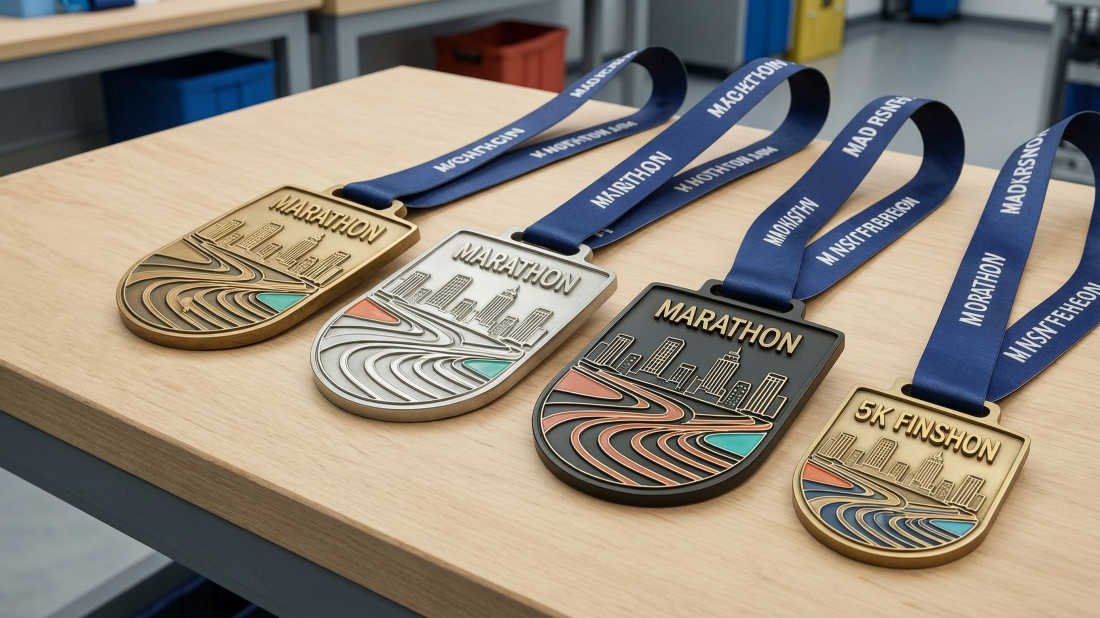
Yes. Multi-distance races often create a medal series with shared visual identity but different distance text, color schemes, ribbon colors, or plating finishes. This makes each distance feel unique while keeping the overall event brand consistent. For example, 5K can use bright colors, 10K can use silver, half marathon can use antique gold, and marathon can use a larger 3D medal.
To make a marathon medal more collectible, include strong storytelling elements such as city landmarks, race route, historical culture, local symbols, elevation lines, iconic finish-line scenery, or annual theme details. Use premium materials, larger size, 3D relief, antique plating, custom ribbon, and possibly special features such as cutouts, moving parts, or dual plating.
Yes. Vistarts can help turn rough ideas, sketches, logos, event themes, and reference images into production-ready custom race medal designs. Our design team understands both visual creativity and manufacturing requirements, helping customers create medals that are beautiful, feasible, and cost-effective.
If you are ready to design custom race medals for a 5K, 10K, half marathon, full marathon, ultramarathon, charity run, school race, corporate event, or international sports competition, Vistarts can help you turn your concept into a production-ready medal that runners will be proud to receive.
Shenzhen Vistarts Craft Co., Ltd. combines creative design, engineering knowledge, strong factory capability, strict quality control, certified production, and reliable delivery. With 15 years of manufacturing experience, a self-owned factory of over 10,000 square meters, more than 150 employees, 5 production lines, over 50 modern machines, a 20+ professional design team, over 20 engineers, and more than 10 QC specialists, we support custom medal projects from initial idea to final delivery.
Whether you need a colorful 5K medal design, a meaningful 10K finisher medal, a premium half marathon medal, a high-end marathon medal design, custom medal ribbon design, 3D race medal artwork, glow-in-the-dark medals, spinning medals, custom-shaped medals, or bulk race medals for a major event, our team is ready to provide a tailored solution.
Contact Vistarts today to start your custom running medal project. Send us your race name, event date, medal quantity, distance categories, logo files, design ideas, preferred medal size, ribbon requirements, and delivery destination. Our experienced team will provide professional suggestions, artwork proofing, material recommendations, production guidance, and a reliable plan to help your event medals stand out.

58 South Union Road, South Union Community, Shenzhen, Guangdong, China