
View:20913Time:2026.07.25
Custom medal size guide: for most running events, custom race medals are usually between 2.5 inches and 4.0 inches. Smaller medals are lighter and more budget-friendly, while larger medals provide more space for 3D details, heavier weight, stronger visual impact, and higher collectible value. In general, medal size should match the race distance, event positioning, participant expectations, design complexity, and total budget.
Choosing the right medal size is one of the most important decisions for race organizers. If the medal is too small, participants may feel it looks cheap or not worthy of their effort. If the medal is too large, it may exceed the budget, increase shipping weight, and become uncomfortable for children or casual participants. The best solution is not always “the biggest medal possible.” The best solution is a balanced size that fits your race category, design concept, ribbon width, production process, and audience.
This complete guide explains the standard race medal size for kids’ runs, 5K races, 10K races, obstacle races, half marathons, full marathons, ultramarathons, and premium sporting events. It also explains how medal thickness affects perceived quality, how every 0.5-inch size increase can affect unit price and shipping weight, why design complexity requires enough surface area, and how to match medal size with ribbon width.
Shenzhen Vistarts Craft Co., Ltd. is a professional custom manufacturer specializing in medals, trophies, badges, keychains, metal cards, promotional gifts, jewelry, and event commemorative products. With a self-owned factory, more than 50 modern machines and equipment, over 20 professional designers, ISO system certification, Disney and Universal Studios factory audit experience, CE and RoHS certified medals, and supply chain experience from top-level events such as the Olympic Games and FIFA, Vistarts helps event organizers select the right medal dimensions and create production-ready custom race medals with strong visual value.
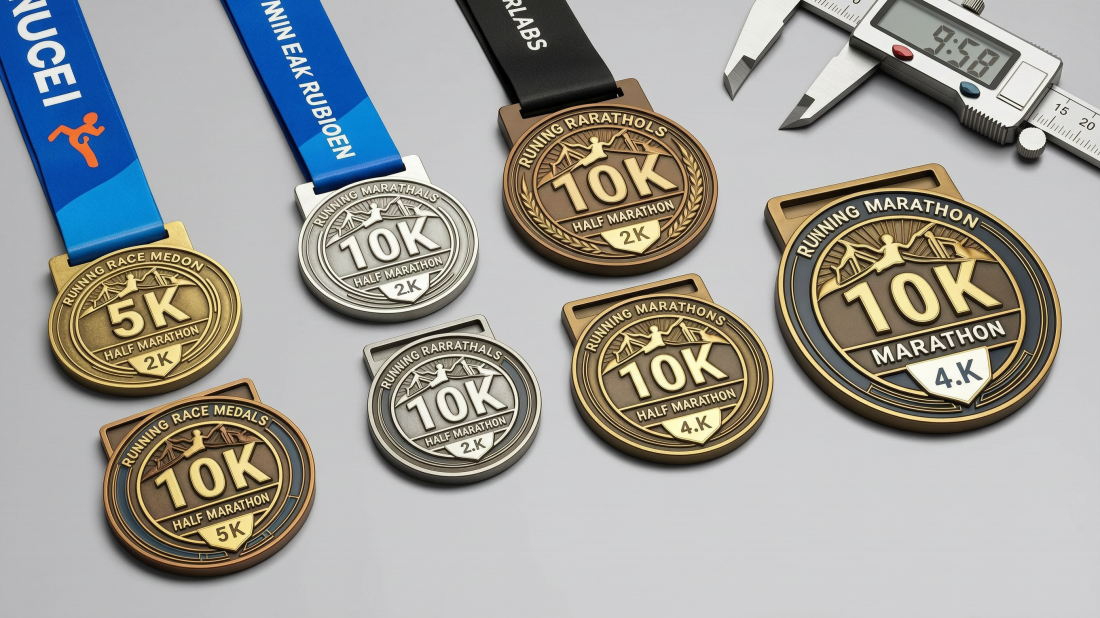
The easiest way to choose a medal size is to start with the race distance. Shorter, casual, and family-friendly events usually use smaller and lighter medals. Longer, more competitive, or premium endurance events usually use larger and heavier medals. The following table provides a practical Custom medal size guide for common running events.
| Race Type | Recommended Medal Size | Common Thickness | Best For | Design Recommendation |
|---|---|---|---|---|
| Kids' Runs | 2.0" – 2.5" | 2.5mm – 3mm | Children, school races, family events | Lightweight, colorful, safe, simple text |
| 5K Races | 2.0" – 2.5" or up to 3.0" for premium events | 3mm | Fun runs, charity runs, community events | Bright enamel, clear 5K text, budget-friendly |
| 10K Races | 2.5" – 3.0" | 3mm | Standard running events, obstacle races | Balanced size, moderate details, strong branding |
| Half Marathons | 3.0" – 3.5" | 3mm – 4mm | 21K events, city races, endurance runners | Landmarks, 2D/3D details, premium ribbon |
| Full Marathons | 3.5" – 4.0"+ | 4mm – 5mm | 42K races, major city marathons | Heavyweight, 3D relief, collectible design |
| Ultramarathons | 3.5" – 4.0"+ | 4mm – 5mm | Trail races, mountain ultras, endurance challenges | Large format, rugged textures, terrain details |
This table is a starting point, not a strict rule. Some premium 5K races use 3.0-inch medals to create stronger perceived value. Some budget-conscious half marathons may choose 3.0-inch medals instead of 3.5-inch medals. Some world-class marathon events may choose medals larger than 4.0 inches to create social media impact and collectible value.
When selecting medal dimensions, organizers should consider not only the diameter or longest side of the medal, but also thickness, metal type, shape, cutouts, plating, enamel, attachments, and ribbon width. A 3.0-inch medal with good thickness and strong design can look more premium than a larger medal with weak artwork.
Kids’ runs and many 5K events usually work best with medals between 2.0 inches and 2.5 inches. This size range is lightweight, easy to wear, cost-effective, and suitable for high-volume events. It is especially useful for school races, youth sports days, charity 5K events, family fun runs, community walks, corporate wellness challenges, and holiday-themed runs.
For children, comfort and safety are extremely important. A large, heavy medal may look impressive in photos, but it can feel uncomfortable around a child’s neck. A smaller medal with a colorful ribbon, rounded edges, simple icons, and bright enamel can deliver a better participant experience.
For a 5K medal size, 2.5 inches is often a practical choice. It offers enough space for the race name, year, “5K,” “Finisher,” and one or two simple graphics. If the event wants a more premium look, 3.0 inches can also be considered, especially for large city 5K races or sponsor-supported events.
The design should remain simple at this size. Avoid trying to include too many sponsor logos, long slogans, detailed maps, or complex 3D landmarks on a 2.0-inch medal. Instead, use a bold event icon, large distance text, and strong color contrast. Soft enamel is a good option for 5K medals because it provides colorful visual impact at a cost-effective price.
For many race organizers, 2.5 inches to 3.0 inches is the industry sweet spot for 10K races, obstacle courses, trail races, charity challenges, and general competition medals. This size range balances cost, weight, visual presence, and design flexibility.
A 10K medal needs to feel more substantial than a basic participation medal, but it does not always need the same size as a full marathon medal. At 2.5 inches, the medal can still be economical and easy to produce. At 3.0 inches, the design has more room for event identity, local landmarks, route elements, sponsor recognition, or 2D/3D mixed structure.
Obstacle course medals often benefit from the 3.0-inch size because the design may include mud, flames, shields, chains, mountains, tire tracks, ropes, or other rugged elements. The extra surface area helps these details remain visible after casting and plating.
For 10K races, a 3mm thickness is usually suitable unless the design has deep 3D sculpting, large cutouts, or functional components. Antique silver, antique bronze, black nickel, and shiny gold are all common plating choices. A custom ribbon width of 1.25 inches or 1.5 inches often works well.
Half marathon medals usually range from 3.0 inches to 3.5 inches. This size gives participants a stronger sense of accomplishment while keeping the medal practical for production and shipping. A half marathon is a serious endurance event, so the medal should feel more premium than a simple 5K award.
A 3.0-inch half marathon medal can work well for standard events, charity half marathons, university races, or regional competitions. A 3.5-inch medal is better for larger events, destination races, city half marathons, themed events, or races that want a stronger social media presence.
The half marathon distance gives designers an opportunity to add meaningful details. Common design elements include local landmarks, city skylines, bridges, rivers, coastal views, route maps, finish-line icons, historic buildings, or cultural symbols. With 3.0 inches or more, these elements can be displayed more clearly.
Vistarts specializes in design with a narrative element. Our team can deeply explore urban landmarks, historical culture, and sports spirit of the event, then transform them into visual symbols with collectible value. This approach is especially useful for half marathon medals, where runners often expect the medal to represent both the distance and the location.
Full marathon and ultramarathon medals usually start at 3.5 inches and often reach 4.0 inches or larger. These events represent major endurance achievements, so participants often expect medals that feel heavy, premium, and highly collectible.
Marathon medal dimensions should provide enough space for advanced details such as 3D relief, multi-layer structures, cutouts, route maps, city landmarks, special plating, spinning centers, or unique shapes. A larger medal can better communicate the difficulty and prestige of the event.
For full marathons, the medal is not just a souvenir. It is a symbol of months of training, personal discipline, and completion of a difficult challenge. A small medal may disappoint runners, especially if the event is positioned as a major city marathon or premium endurance race. A 3.5-inch to 4.0-inch medal with a 4mm or 5mm thickness can create a stronger emotional and physical experience.
Ultramarathon medals can use rugged and symbolic design language. Mountain profiles, elevation maps, trail lines, compass details, forest textures, rocks, rivers, and terrain relief can all be integrated into the medal design. These details usually require larger medal dimensions to remain sharp and readable.
Vistarts offers over 1,000 custom medal designs, including spinning, 3D, round, square, custom-shaped, glow-in-the-dark, and more. Our high-fidelity 3D rendering design can simulate real lighting, metal refraction, and detailed textures, helping customers preview the final look before production.
Medal thickness has a major influence on how the medal feels in the hand. Two medals may have the same diameter, but the thicker medal usually feels more valuable, more durable, and more premium. Thickness also affects whether the design can support deep 3D sculpting, bottle-opener function, moving parts, or heavy cutouts.
When using this Custom medal size guide, remember that size and thickness should be considered together. A large medal that is too thin may feel weak or cheap. A small medal that is too thick may become unnecessarily heavy and expensive. The right thickness depends on the medal diameter, material, shape, design depth, and event positioning.
| Medal Thickness | Recommended Medal Size | Best Use | Look and Feel |
|---|---|---|---|
| 2.5mm | 2.0" – 2.5" | Kids’ runs, simple 5K medals, budget medals | Lightweight and economical |
| 3mm | 2.5" – 3.0" | Standard race medals, 5K, 10K, flat 2D designs | Balanced and practical |
| 4mm | 3.0" – 3.5" | Half marathons, premium 10K medals, light 3D details | More solid and premium |
| 5mm | 3.5" – 4.0"+ | Full marathons, ultras, bottle openers, deep 3D medals | Heavy, high-end, collectible |
A 3mm thickness is one of the most common choices for standard race medals. It works well for medals between 2.5 inches and 3.0 inches, especially when the design is mainly 2D or has shallow relief. This thickness offers a good balance between cost, durability, and perceived quality.
For 5K and 10K medals, 3mm is usually enough. It allows raised metal lines, recessed enamel filling, clear text, and basic custom shapes. It is also suitable for many promotional medals, school race medals, charity run medals, and standard finisher medals.
If your design does not include deep 3D sculpting, moving parts, thick layered elements, or functional features, 3mm can keep the medal cost-effective while still feeling solid. This is why many organizers choose 3mm as the default standard thickness.
For large medals of 3.5 inches or more, a heavyweight thickness of 4mm to 5mm is often recommended. This is especially important for full marathon medals, ultramarathon medals, premium event awards, bottle-opener medals, spinner medals, and medals with deep 3D relief.
A large medal with only 2.5mm thickness may look wide but feel thin. It may not support deep sculpting or strong structure. A 4mm or 5mm thickness gives the medal a more substantial hand feel and better structural strength.
Bottle-opener medals require enough thickness to function properly and resist bending. Spinner medals and multi-part medals also need sufficient thickness to hold mechanical components, rivets, or rotating centers. Deep 3D sculpted medals need extra metal depth so the relief can show realistic light and shadow.
Vistarts’ engineers can review your medal concept and recommend the right thickness according to the size, function, material, and production method. This helps prevent designs that look good on screen but are too weak or impractical in real production.
The standard size for medals depends on more than race distance. A smart medal size decision should also consider budget, target audience, design complexity, special functions, delivery timeline, shipping method, and event brand positioning.
Below are the most important factors to review before confirming your medal dimensions.
Budget is often the first practical factor. Medal size directly affects metal consumption, mold complexity, polishing time, plating surface area, enamel area, packaging size, and shipping weight. Every 0.5-inch increase may raise the unit price, especially when combined with greater thickness or special processes.
For example, moving from a 2.5-inch medal to a 3.0-inch medal may seem like a small change, but it increases the medal surface area and total metal usage. Moving from 3.0 inches to 3.5 inches can make an even bigger difference, especially if the medal also changes from 3mm to 4mm thickness. A 4.0-inch medal with 5mm thickness, 3D relief, cutouts, and dual plating will naturally cost more than a simple 2.5-inch soft enamel medal.
Shipping weight is another important cost factor. Large medals are heavier, and bulk orders can become significantly more expensive to ship. If you are ordering thousands of medals, even a small increase in individual medal weight can affect total freight cost.
Vistarts works with more than 10 logistics channels to offer faster, more versatile, and cost-effective shipping options. Our team can help you balance medal dimensions, thickness, material, and shipping method to meet your delivery deadline and budget requirements.
Your target audience should strongly influence medal size. Kids, casual walkers, first-time 5K participants, corporate teams, charity supporters, and elite marathoners do not all have the same expectations.
Kids usually prefer lighter medals that are easy and comfortable to wear. Bright colors, fun shapes, friendly icons, and soft ribbon materials may matter more than heavy weight. A 2.0-inch to 2.5-inch medal is often enough for children’s races.
Casual 5K participants often appreciate a medal that is cheerful, memorable, and easy to photograph. A 2.5-inch medal can work well, while a 3.0-inch medal can create a stronger premium feel for larger events.
Professional marathoners and serious endurance athletes often value heavier and more detailed medals. They may compare medals from different races, share them online, and display them at home. For this audience, a 3.5-inch to 4.0-inch medal with strong design and premium finishing can significantly improve event reputation.
The best approach is to match medal size with the emotional weight of the achievement. A child’s fun run medal should feel exciting and comfortable. A marathon medal should feel earned, substantial, and collectible.
Complex designs need more space. If your medal includes detailed 3D landmarks, city skylines, bridges, mountain ranges, route maps, sponsor logos, multiple distance categories, cutouts, or layered structures, a medal smaller than 3.0 inches may not provide enough room.
When details are compressed into a small medal, thin lines may disappear, tiny text may become unreadable, and enamel areas may become too narrow to fill cleanly. This is one of the most common production problems in custom medal projects.
For detailed 3D race medals, 3.0 inches should usually be considered the minimum starting point. For full marathon medals with deep relief and storytelling elements, 3.5 inches or larger is often better. If the design includes a famous landmark or complex event story, larger dimensions allow the artwork to breathe.
Vistarts provides 3D high-definition dynamic rendering design. We can simulate real lighting, metal refraction, and detailed texture so customers can better understand how the size and design will appear before mass production.
Special medal functions often require extra surface area and thickness. Spinner medals need enough room for the rotating part and the surrounding frame. Puzzle-piece medals need shape accuracy so different pieces connect properly. Bottle-opener medals need enough metal strength around the functional opening. Glow-in-the-dark areas, layered designs, and moving parts also need careful space planning.
If you want a spinner medal, 3.0 inches is often the minimum practical size, while 3.5 inches or larger gives better results. For bottle-opener medals, 4mm to 5mm thickness is usually recommended to improve strength and usability. For puzzle medals, each piece must be large enough to show its own design while fitting into the full set.
Special functionality is a great way to make your medals memorable. However, it should not be added only for novelty. The function should support the event theme. For example, a brewery 5K may use a bottle-opener medal. A multi-race challenge may use puzzle medals. A city marathon may use a spinner element to show a landmark, compass, wheel, or route feature.
Vistarts has experience with multiple medal structures and processes, including spinning, 3D, custom-shaped, glow-in-the-dark, and other creative designs. Our design team can help judge whether your special function is practical at the desired size.
Medal size and ribbon size should be designed together. A beautiful medal can look unbalanced if the ribbon is too narrow, too wide, too short, or visually disconnected from the medal body. The ribbon is not only a hanging accessory; it is part of the complete award design.
The ribbon affects comfort, photography, sponsor visibility, and perceived quality. It also provides extra branding space for the event name, sponsor logos, distance, date, slogan, and color pattern. For many events, the custom ribbon is where repeated branding works best.
The general rule is simple: smaller medals use narrower ribbons, while larger medals use wider ribbons. Below is a practical ribbon width guide:
| Medal Size | Recommended Ribbon Width | Best Use | Design Notes |
|---|---|---|---|
| 2.0" – 2.5" Medals | 1.0" or 1.25" Wide Ribbon | Kids’ runs, 5K races, school events | Lightweight and balanced; suitable for simple logos |
| 2.5" – 3.0" Medals | 1.25" or 1.5" Wide Ribbon | 5K, 10K, obstacle races | Good space for event name and sponsor logos |
| 3.0" – 4.0" Medals | 1.5" or 2.0" Wide Ribbon | Half marathons, marathons, ultras | Premium appearance and better support for heavy medals |
| 4.0"+ Medals | 2.0" Wide Ribbon or custom width | Luxury marathon medals, challenge medals | Best for heavy medals and bold branding |
For a 2.0-inch to 2.5-inch medal, a 1.0-inch or 1.25-inch ribbon usually looks proportional. For 3.0-inch to 4.0-inch medals, a 1.5-inch or 2.0-inch ribbon often provides better balance and comfort. Heavy marathon medals should not be paired with very narrow ribbons because the medal may hang awkwardly and feel less premium.
Dye-sublimation ribbon printing is a strong option for full-color designs, gradients, sponsor logos, and event graphics. It allows the ribbon to match the medal enamel, plating, and event branding. Vistarts can coordinate medal and ribbon design together to create a unified product.
Race distance is important, but event positioning is also critical. Two races with the same distance may need different medal sizes depending on brand image, registration fee, sponsor support, participant expectations, and marketing goals.
| Event Positioning | Recommended Medal Size | Recommended Thickness | Suggested Features |
|---|---|---|---|
| Budget Community Event | 2.0" – 2.5" | 2.5mm – 3mm | Simple shape, soft enamel, standard plating |
| Standard Local Race | 2.5" – 3.0" | 3mm | Custom shape, event logo, colorful ribbon |
| Premium City Race | 3.0" – 3.5" | 3mm – 4mm | Landmarks, antique finish, 2D/3D combination |
| Major Marathon | 3.5" – 4.0"+ | 4mm – 5mm | 3D relief, dual plating, cutouts, premium ribbon |
| Collector Series / Challenge Event | 3.5" – 4.0"+ | 4mm – 5mm | Spinner, puzzle, glow-in-the-dark, multi-piece design |
For a budget community race, a smaller medal may be perfectly acceptable if the design is thoughtful and the ribbon looks professional. For a premium city marathon, a larger medal is often expected because participants have invested more time, energy, and registration cost.
Organizers should ask: What do participants expect from this event? Will they post the medal on social media? Is the medal part of the race marketing strategy? Does the event compete with other local races? Is the medal used to encourage repeat registration next year?
If medals are part of your event’s brand reputation, investing in the right size and design can improve participant satisfaction and increase the chance of organic social sharing.
Different materials and processes perform better at different sizes. The standard size for medals should be selected with production feasibility in mind.
| Process / Material | Recommended Minimum Size | Best Medal Type | Why Size Matters |
|---|---|---|---|
| Flat 2D Iron Medal | 2.0" – 2.5" | Budget 5K, school medals, promotional medals | Simple designs can remain clear at smaller sizes |
| Zinc Alloy Custom Shape | 2.5" – 3.0" | 10K, half marathon, themed medals | Allows better shape detail and cutout structure |
| 3D Relief Medal | 3.0"+ | Half marathon, marathon, landmark medals | Needs space for sculpted depth and visible details |
| Spinner Medal | 3.0" – 3.5"+ | Challenge runs, premium events | Needs room for rotating center and frame |
| Bottle-Opener Medal | 3.0"+ | Brewery runs, festival races, fun events | Needs structural strength and functional opening |
| Puzzle Medal Set | 3.0"+ per piece | Multi-race series, challenge medals | Each piece must show design and connect accurately |
| Glow-in-the-Dark Medal | 2.5"+ | Night runs, themed races | Needs enough enamel area for glow effect |
Zinc alloy is commonly recommended for custom-shaped medals, deep 3D medals, cutouts, and larger premium designs. Iron can be a practical choice for simpler flat medals and budget-friendly events. Vistarts’ factory customization capabilities allow us to meet different process requirements and help customers select the right material for the desired medal size.
Even experienced event organizers can make mistakes when selecting medal dimensions. Below are common issues to avoid.
A small medal cannot hold unlimited details. If your design includes tiny sponsor logos, long event names, maps, landmark textures, and multiple colors, a 2.0-inch medal may not work. Increase the size or simplify the design.
A 4.0-inch medal with insufficient thickness may look wide but feel weak. Larger medals usually need 4mm to 5mm thickness to feel premium and support deeper structures.
Medal weight affects shipping cost. A heavier medal may improve perceived quality, but for large quantity orders, total freight cost can increase quickly. Always consider unit weight and delivery destination before finalizing the size.
Multi-distance races should consider different medal sizes or at least different designs for each distance. A 5K, 10K, half marathon, and full marathon can share a consistent event identity while using different sizes, colors, ribbons, or plating finishes.
A medal and ribbon should look like one complete product. A narrow ribbon on a heavy marathon medal may look unbalanced. A very wide ribbon on a small kids’ medal may look oversized. Match the ribbon width to the medal dimensions.
Vistarts does more than manufacture medals. We help customers make practical and strategic decisions about medal size, thickness, material, structure, design complexity, ribbon width, production timeline, and shipping method.
Vistarts has a team of over 20 designers who understand both design and production costs. This means we can recommend medal dimensions that make the design more practical, feasible, and cost-effective. We help prevent problems such as unreadable tiny details, weak structures, inappropriate thickness, and unbalanced ribbon proportions.
Our 3D rendering service simulates real lighting, metal refraction, plating color, enamel texture, and detailed surface effects. This helps customers compare different sizes and understand how the medal will look before approving production.
Vistarts has a self-owned factory, over 50 modern machines and equipment, 5 production lines, and more than 20 professional engineers. These capabilities allow us to produce custom medals with different sizes, thicknesses, shapes, structures, and finishing processes.
Vistarts has passed ISO9001, ISO45001, and ISO14001 certification. Our medals have CE and RoHS certifications. Our factory has also passed inspections by Disney and Universal Studios. We provide full-chain quality control from raw materials to production and final inspection, helping ensure mass production quality matches the confirmed sample.
Vistarts has supply chain experience from top-level events such as the Olympic Games and FIFA, and has collaborated with major international events including the Paris Olympics, Qatar World Cup, and renowned marathon events. We understand the importance of event deadlines, quality consistency, professional communication, and participant satisfaction.
The most popular race medal size is usually around 3.0 inches. This size works well for many 5K, 10K, obstacle race, charity race, and standard running events because it balances cost, weight, and design space. For half marathons, 3.0 inches to 3.5 inches is common. For full marathons and ultramarathons, 3.5 inches to 4.0 inches or larger is often preferred.
The weight of a 3-inch metal medal depends on material, thickness, shape, cutouts, and plating. A standard 3-inch medal with 3mm thickness may feel balanced and practical for most race events. If the medal uses zinc alloy, deep 3D relief, fewer cutouts, or thicker construction, it will weigh more. For accurate weight estimation, the manufacturer should calculate the weight based on the final design drawing and selected material.
Bigger medals are not always better. Large medals can feel premium and collectible, especially for marathons and ultramarathons, but they also cost more and increase shipping weight. For children’s races, casual 5K events, or budget-friendly community runs, a smaller and lighter medal may provide a better experience. The best medal size should match the event level, audience, budget, and design complexity.
The standard 5K medal size is usually between 2.0 inches and 2.5 inches, although premium 5K events may use 3.0-inch medals. A 2.5-inch medal is a practical choice for many fun runs, charity events, and community races because it is lightweight, affordable, and large enough for basic race information.
Common marathon medal dimensions are usually 3.5 inches to 4.0 inches or larger. Marathon medals often use 4mm to 5mm thickness, 3D relief, antique plating, custom shapes, cutouts, and premium ribbons to create a heavier and more collectible finish.
A half marathon medal is commonly between 3.0 inches and 3.5 inches. This size provides enough space for the race name, year, 21K or half marathon text, local landmarks, and detailed design elements while keeping cost and shipping weight manageable.
Yes. Medal thickness is very important because it affects the weight, durability, and perceived quality. A 3.0-inch medal with proper thickness can feel more premium than a larger medal that is too thin. Standard medals often use around 3mm thickness, while large marathon medals and 3D sculpted medals may use 4mm to 5mm thickness.
Yes. Many multi-distance events use different medal sizes or designs for each distance. For example, a 5K medal may be 2.5 inches, a 10K medal may be 3.0 inches, a half marathon medal may be 3.5 inches, and a marathon medal may be 4.0 inches. This helps participants feel that each distance has its own achievement level.
For a 3-inch medal, a 1.25-inch or 1.5-inch wide ribbon is commonly recommended. If the medal is heavier or positioned as a premium award, a 1.5-inch ribbon can provide better balance and more branding space.
Yes. Vistarts can recommend suitable medal size, thickness, material, plating, enamel, ribbon width, and packaging based on your race type, quantity, budget, design complexity, and delivery timeline. Our design team and engineers work together to provide production-ready solutions for custom race medals.
Selecting the right race medal size is a balance between participant expectations, event level, design detail, budget, production feasibility, and shipping cost. A 2.5-inch medal may be perfect for a colorful community 5K. A 3.0-inch medal may be the ideal standard race medal size for 10K events and obstacle courses. A 3.5-inch medal can make a half marathon feel more premium. A 4.0-inch or larger medal can turn a full marathon or ultramarathon award into a highly collectible symbol of achievement.
If you are unsure which size to choose, Vistarts can help. Shenzhen Vistarts Craft Co., Ltd. has 15 years of manufacturing experience, a self-owned factory of over 10,000 square meters, more than 150 employees, over 50 modern machines and equipment, 5 production lines, over 20 professional engineers, a design team of over 20 professionals, and a dedicated QC team of more than 10 people. We provide custom medal solutions for running events, competitions, promotional campaigns, collectible souvenirs, gifts, and international sports events.
Whether you need a Custom medal size guide, a standard 5K medal size recommendation, marathon medal dimensions, ribbon width suggestions, 3D medal artwork, spinning medals, custom-shaped medals, glow-in-the-dark medals, or bulk race medal production, our team is ready to provide professional support from concept to delivery.
Contact Vistarts today to start your custom race medal project. Send us your race distance, event date, quantity, budget range, logo, medal concept, preferred size, ribbon requirements, and delivery destination. Our team will help you choose the right standard size for medals, create a production-ready design, control quality, and deliver your medals on time for a successful event.

58 South Union Road, South Union Community, Shenzhen, Guangdong, China