View:92353Time:2026.09.15
Choosing the right custom medal manufacturer is one of the highest-stakes sourcing decisions an event organizer or B2B buyer makes, because unlike most purchases, there is no second chance — race day, tournament finals, and awards ceremonies happen on a fixed date whether your medals arrive or not. A supplier who quotes attractively but lacks real production capacity, technical design expertise, or reliable logistics can turn what should be a straightforward procurement task into a genuine crisis. This guide breaks down the five core dimensions every B2B buyer should evaluate when screening a custom medal manufacturer: whether they are a genuine factory or a middleman, the strength of their in-house design and proofing capability, the realism of their production lead times, the rigor of their quality control standards, and the transparency of their pricing and shipping terms.
Here's a quick-reference summary of the five evaluation dimensions covered in this guide, and what separates a strong custom medal manufacturer from a risky one.
| Evaluation Dimension | Strong Manufacturer | Warning Sign |
|---|---|---|
| Production Source | Owns the factory; direct access to production engineers | Outsources to an unnamed third-party factory |
| Design Capability | In-house team providing free 2D/3D proofs; handles intricate sculpting | Charges for basic proofs; cannot advise on casting limits |
| Lead Time | Realistic 12–18 day production window stated clearly | Always promises the fastest possible date regardless of order |
| Peak Season Capacity | Multiple production lines absorbing spring/fall surges | Single line; every client queued behind the same backlog |
| Quality Control | Dedicated QC team; raw material to final packing inspection | Spot checks only at final packing, if at all |
| Pricing | Itemized: mold, unit cost, ribbon, hardware, shipping | Vague lump sum with fees confirmed later |
| Shipping | DDP door-to-door with customs clearance handled | FOB only; customs and freight left entirely to you |
The first and most consequential question in any custom medal manufacturer evaluation is simply whether you are talking to the people who will actually make your medals.
Working directly with a genuine factory removes a markup layer, but the more significant benefit is often technical rather than financial. When you have direct access to production engineers, design questions get answered by the people who actually understand the mold — whether a particular cutout depth is castable, whether a piece of fine text will survive plating, whether a spinning mechanism can be engineered to the durability standard you need. That direct line also translates into genuine flexibility on complex custom requests: a factory can adjust tooling, test an alternative plating approach, or restructure a design for cost efficiency in ways a reseller simply cannot, because a reseller has to relay every question through an intermediary with its own priorities and timeline.
Trading companies rarely announce themselves. The reliable tells are technical: ask a specific question about casting limits — minimum castable text height, achievable relief depth on a given medal thickness, how a particular enamel color behaves over antique plating — and note whether you get a confident, specific answer or a vague deflection followed by a suspiciously long delay while they check with someone else. Other common indicators include reluctance to share real photographs or video of the production floor, an inability to name their own equipment or production line configuration, and quotes that shift as you press for specification detail. Any one of these alone may be innocuous; together they strongly suggest you are not talking to the manufacturer.
A medal design that looks stunning on screen does not automatically translate into a medal that casts cleanly in metal — which makes design and proofing capability a genuine differentiator between manufacturers.
A capable custom medal manufacturer should provide professional 2D and 3D digital artwork proofs as a standard part of the process, ideally free of charge and with a reasonable number of revision rounds included. These proofs are your primary opportunity to catch proportion issues, text placement problems, spelling errors, and relief depth concerns before any tooling is cut — the point at which corrections are effectively free. A supplier who treats proofing as a paid add-on, or who pushes to skip straight from a rough concept to mass production, is shifting substantial risk onto you for no corresponding benefit.
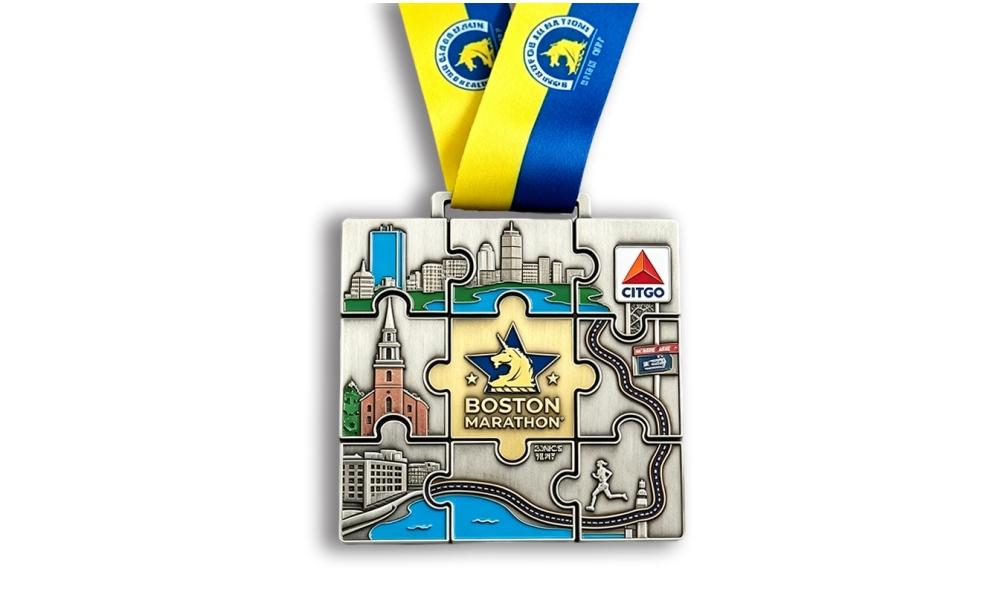
Not all design teams are equal, and the gap becomes obvious in the hardest cases. Sculpting a convincing human figure in motion — a runner mid-stride, a dancer in an extended pose, a player mid-shot — requires real anatomical understanding rendered within the physical constraints of casting depth. The same applies to realistic sports equipment texture (a pebbled basketball surface, a woven net, a tire tread) and detailed textured backgrounds like city skylines or topographic relief. Ask to see examples of the factory's most intricate past work specifically, rather than their cleanest and simplest designs, since that is where the difference between a genuinely skilled in-house sculpting team and a basic artwork service becomes visible.
Event dates are immovable, which makes lead time reliability functionally as important as price in any manufacturer comparison.
Ask for the factory's standard production window for an order comparable to yours in size and complexity — typically in the range of 12–18 days for mold-making through mass production and quality inspection, depending on design complexity and volume. Be appropriately skeptical of any supplier promising dramatically faster timelines than the rest of the market for the same specification, since compressed schedules usually come from somewhere: reduced QC checkpoints, rushed plating cycles, or simply an optimistic number that will quietly slip once the order is placed and your deposit has cleared.
Spring and fall are peak season for running events globally, and medal factories frequently run multiple large orders simultaneously during these months. Ask directly how the manufacturer manages capacity during peak periods: do they operate multiple production lines that can absorb concurrent large orders, or does every client queue behind the same single line? A factory with several dedicated production lines, a substantial workforce, and a large equipment base is structurally far better positioned to protect your delivery date during high-demand months than a small workshop, regardless of what either promises verbally.
Quality problems discovered after mass production are expensive, time-consuming, and frequently impossible to remedy before an event date — which makes a manufacturer's QC infrastructure worth examining closely before you order.
Confirm explicitly which base metal will be used — zinc alloy supports far finer casting detail and better corrosion resistance than cheaper alternatives — and ask about plating thickness and consistency standards. Plating is a common place for quiet cost-cutting: a layer applied too thinly may look fine on delivery day but wear through within months, exposing the base metal to oxidation and undermining the medal's value as a long-term keepsake. Relevant certifications (such as ISO9001 quality management, and RoHS/CE material compliance) are useful evidence that these standards are documented and audited rather than merely claimed.
Ask where inspection actually happens in the production process, not just whether QC exists. Strong manufacturers inspect at multiple checkpoints — incoming raw materials, in-process production, and finished goods before packing — rather than performing a single cursory check at the end. Specific things worth confirming they inspect for: smooth, burr-free polishing on medal edges, reinforced V-sew ribbon stitching at the high-stress attachment point, and accurate Pantone color matching on enamel fills across the entire batch rather than just the first units off the line. The size of the dedicated QC team relative to production volume is a useful practical indicator of how seriously this is taken.
The final evaluation dimension is whether the price you are quoted bears a meaningful relationship to what you will actually pay.
Require a fully itemized quote before committing to anything. It should separately identify the one-time mold and tooling fee, the per-unit production cost at your specific quantity, custom ribbon printing and hardware costs, packaging, and shipping. Two follow-up questions are worth asking every time: is there an order volume at which the mold fee is waived, and does the factory retain your mold for future reorders without re-charging tooling? For recurring annual events, the answer to the second question can represent substantial savings across multiple seasons.
DDP shipping terms place responsibility for export clearance, international freight, import duties, and customs clearance on the manufacturer, with the medals delivered directly to your venue or office. For event organizers — who are frequently volunteers or part-time administrators rather than import professionals — this removes a genuinely significant burden and eliminates the risk of a shipment sitting at customs while your event date approaches. It also makes cross-vendor price comparison meaningful, since a DDP quote reflects your true landed cost rather than a port-side figure that excludes several unquantified downstream expenses.
Ask for verifiable evidence rather than claims: real photographs or video of their production floor and equipment, quality management certifications such as ISO9001, material compliance documentation (RoHS/CE), any third-party factory audit approvals they hold, and named examples of past client projects. A legitimate factory will answer detailed technical questions about casting, plating, and mold engineering confidently and specifically, and will readily provide a physical sample before you commit to a full production run.
Yes — for any order of meaningful size, this is the single most effective safeguard available to you. Digital renderings cannot convey a medal's actual weight in hand, the true shade of a plating finish under real lighting, or how enamel colors read in person, and they can hide detail loss that only becomes apparent once the design is cast. Reviewing a physical pre-production sample before authorizing mass production is what turns a costly batch-wide error into a free five-minute correction. Build the time for this step into your event timeline rather than treating it as optional.
A local trophy shop typically acts as a reseller — taking your order, applying a markup, and forwarding production to an overseas factory you never interact with. The tradeoff is convenience and easier in-person communication versus higher unit cost, limited design flexibility, and slower resolution when technical questions or quality issues arise, since every exchange passes through an intermediary. Working factory-direct generally means lower pricing, direct access to production engineers for complex design questions, and broader manufacturing capability — provided you choose a factory with transparent pricing, solid proofing practices, and DDP logistics to manage the international side smoothly.
Every dimension covered in this guide describes what a strong custom medal manufacturer should offer — and it's exactly how Shenzhen Vistarts Craft Co., Ltd. is built. We are a self-owned factory established in 2011, with over 10,000 square meters of production space, 150+ employees, 50+ modern machines, 20+ professional engineers, and 5 dedicated production lines designed to absorb peak-season volume without pushing back your delivery date.
Our in-house design team of 20+ professionals brings hands-on production expertise to intricate sculpting work — human figures, sports equipment textures, and detailed backgrounds — and provides free 2D/3D digital artwork proofs plus pre-production physical samples before mass production begins. Quality is backed by ISO9001 certification, RoHS and CE compliant materials, a dedicated 10+ person QC team inspecting from raw material through final packing, and factory audit approval from Disney and Universal Studios, with a full refund guarantee if bulk production ever deviates from your approved sample. With over 1,000 existing custom medal designs, 15 years of manufacturing experience including medals connected to the Paris Olympics, Qatar World Cup, and renowned marathon events, and DDP door-to-door shipping through 10+ logistics partners, we handle the international complexity so you can focus on your event.
Evaluating manufacturers for your next medal order? Put us through the checklist. Send your specifications to our sales team — with 3+ years of dedicated order-follow-up experience — and we'll return an itemized, all-inclusive quote along with any production details you want to verify. Visit vistarts.com to get started today.

58 South Union Road, South Union Community, Shenzhen, Guangdong, China